
Published: 9 August 2026 · Last updated: 28 September 2026 · Last reviewed against official sources: 28 September 2026
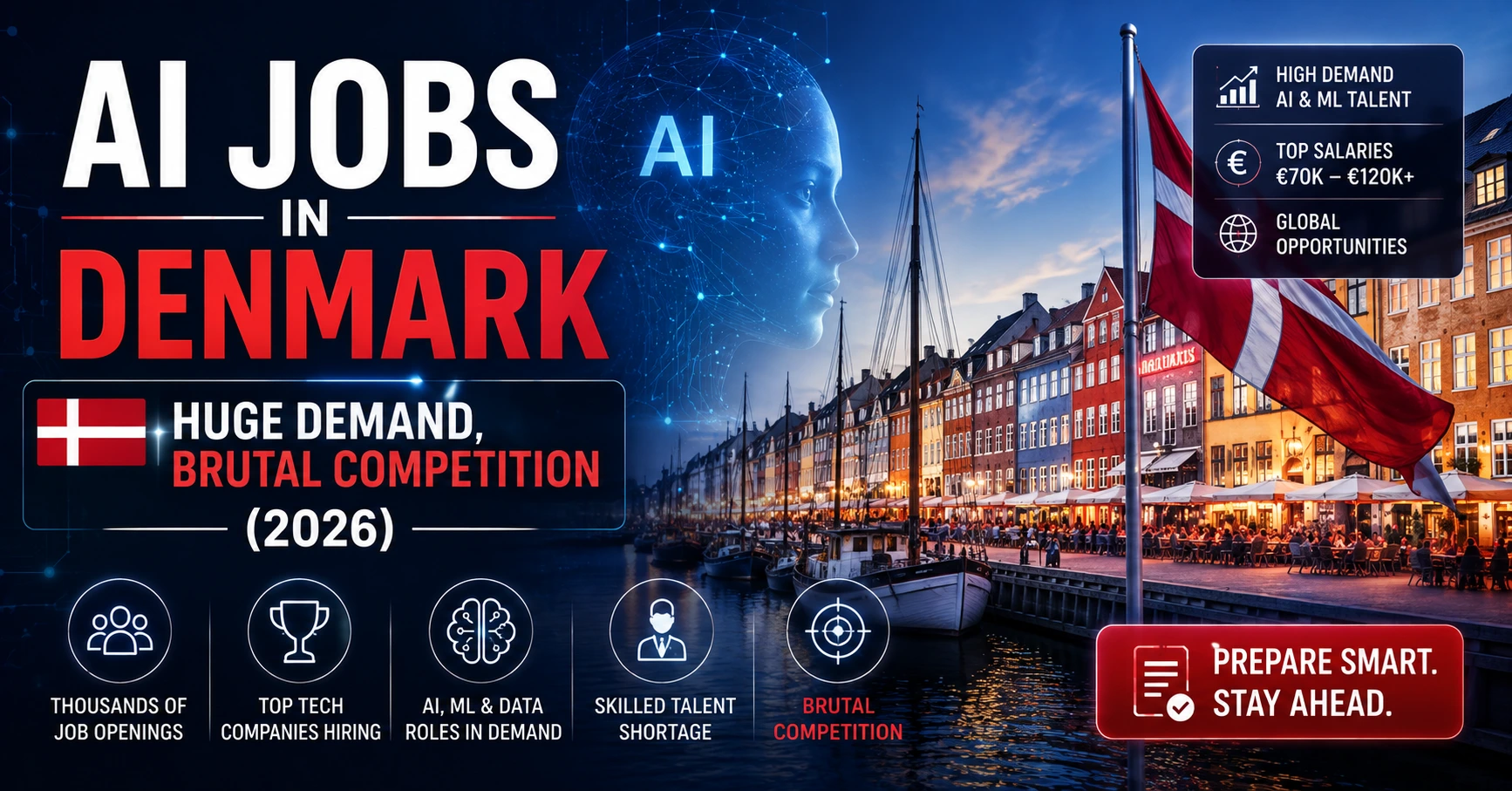
AI jobs in Denmark are some of the best paid and hardest to fill roles in the country. Most sit in the Copenhagen area. Pay starts near 450,000 DKK for a junior and passes 1 million DKK for senior specialists. English is the working language at many employers, so Danish helps but is rarely required. Applicants from outside the EU normally enter through the Pay Limit Scheme, which asks for at least DKK 552,000 in 2026.
Why Denmark Has So Much AI Work Right Now
Denmark is the most AI heavy business economy in the European Union. In 2025, 42% of Danish companies with at least 10 employees used some form of AI technology, against an EU average of 20%.
That figure matters more than any hype cycle. When a company moves from one pilot to fifteen live systems, it needs data engineers, MLOps people and somebody accountable when a model drifts. Most Danish openings are this kind of unglamorous production work.
Infrastructure followed the money. Gefion, Denmark’s national AI supercomputer, went live in Copenhagen in late 2024 with 1,528 NVIDIA H100 GPUs. It is owned by the Danish Centre for AI Innovation, funded by the Novo Nordisk Foundation and the state fund EIFO.
Policy pushed the same way, with roughly 800 million DKK committed under the national digitalisation strategy for 2024 to 2027. Be realistic though. PwC found Danish job postings mentioning AI have hovered between 22,000 and 24,000 since 2022. AI jobs in Denmark are a normal requirement now, not a gold rush.
What AI Jobs in Denmark Actually Pay
Salaries are high by European standards and tightly clustered. Junior roles open around 450,000 to 550,000 DKK. Mid level engineers sit between 600,000 and 750,000 DKK. Senior specialists in Copenhagen commonly land between 800,000 and 1.2 million DKK.
| Level | Annual Base Salary (DKK) | Notes |
|---|---|---|
| Junior AI or ML Engineer | DKK 450,000 – 550,000 | Danish degree helps |
| Mid-Level AI Engineer | DKK 600,000 – 750,000 | National average near DKK 653,000 |
| ML Software Engineer | DKK 490,000 – 865,000 | Average near DKK 709,000 |
| Senior or Principal | DKK 800,000 – 1,200,000 | GenAI, LLM and MLOps depth |
| Copenhagen Premium | About 7% above average | Rent eats the gain |
Look past the headline number. Pension, bonus and share plans typically add another 20% to 40% on top of base pay at larger firms. A 700,000 DKK offer with 12% pension beats a 750,000 DKK offer with none.
Tax is the part newcomers get wrong. Standard rates climb past 50% for higher earners, but specialists recruited from abroad can apply for the researcher tax scheme, a flat 32.84% for up to seven years. From January 2026 the threshold fell to DKK 65,400 monthly, pulling more roles inside it.
Job titles mislead here. A specialist at one employer maps to a junior engineer at another, and a consultancy manager may be doing senior individual work. Translate the title into real scope before judging an offer.
- Get the pension percentage in writing before negotiating.
- Check the contract clears the researcher tax threshold.
- Compare Copenhagen and Aarhus offers after rent.
- Ask what the team shipped last year.
Which Companies Are Hiring
The biggest employers are old industrial names doing new work. Novo Nordisk and Lundbeck hire for drug discovery. Maersk works on route optimisation and forecasting. Vestas and Ørsted run predictive maintenance across wind assets. Danske Bank and Nordea build fraud and risk systems.
Consultancies form the second layer and hire steadily, because their clients cannot staff internally. Netcompany, Implement Consulting Group and the global firms all recruit in Copenhagen. Universities and municipalities add a quieter stream of public roles with good hours and modest pay.
Startups are fewer but strong on reputation. Corti, a Copenhagen speech AI company used in emergency and clinical settings, is the best known. Trustpilot, Zendesk, Unity and Milestone Systems round out a product scene that hires internationally by default.
One honest warning. The same firms creating AI jobs in Denmark are cutting elsewhere. Nordea said in March 2026 that around 1,500 roles would be affected across 2026 and 2027 under a strategy tied to technology and AI. Building the systems is safer than being administered by one.
Skills Danish Employers Actually Test
Python is assumed, not impressive. What gets tested is whether you write code another engineer can maintain, using pandas and scikit-learn without turning a notebook into a monument. Most interviews include a practical task or a walkthrough of something you shipped.
Statistics and evaluation come next. Expect questions on experiment design, overfitting, and how you knew a model was good enough to release. Teams here are small, so nobody has a colleague who quietly does the maths.
The third pillar is engineering around the model. SQL, cloud platforms, containers and monitoring appear in most mid level AI jobs in Denmark and above. MLOps experience is the fastest route into the senior bands.
Then come regulation and communication. The EU AI Act brings high risk system rules into force during August 2026, so health, finance and public employers want documentation skills. Danish workplaces are flat, so you will often explain your work to non technical people.
- Show one production system end to end.
- Learn enough Kubernetes and CI to deploy a model.
- Explain model risk in plain language.
- Pick a domain: health, energy, logistics or finance.
Work Permit Routes for Non EU Candidates
Citizens of the EU, EEA and Switzerland can simply move and start working. Everyone else needs a residence and work permit, and most AI jobs in Denmark run through two routes: the Pay Limit Scheme and the Positive List.
The Pay Limit Scheme is simplest. If your offer pays at least DKK 552,000 per year in 2026, you qualify regardless of field or education. A supplementary version exists at DKK 446,000 with extra conditions. Salary must reach a Danish bank account.
The Positive List works differently. It names shortage occupations, and from 1 January 2026 the higher education list held 183 job titles and the skilled worker list held 57. Salary only needs to match normal Danish levels. Both lists change every January and July.
Speed depends on your employer. Companies certified by the Danish agency SIRI can use the Fast Track Scheme, which sometimes allows a start within days. Thresholds rise each January, but extensions follow the threshold from your first permit.
How to Apply Without Wasting Six Months
Start with the right boards. WorkinDenmark is the government service built for international candidates and carries thousands of English language vacancies. Jobindex is the largest general portal. The Hub covers startups, and LinkedIn works well for Copenhagen tech.
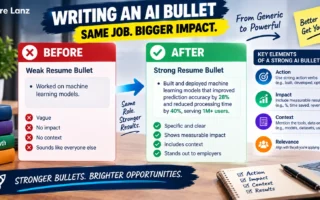
Danish CVs are plain and short. Two pages maximum, no photo, no personal statement. Lead each role with a measurable outcome, such as cutting inference cost by 40% or shipping a forecasting model used daily by three teams.
Say the quiet part out loud. Many hiring managers avoid international candidates because they expect paperwork chaos. One line stating which permit route you qualify for, and asking whether the company is Fast Track certified, removes that worry.
Networking still decides borderline cases. A Danish MSc or PhD acts as local proof, and student assistant roles are a standard entry path. If you are already in Europe, one Copenhagen meetup beats a hundred cold applications.
- Apply through the company site, not the aggregator.
- Rewrite the top three lines per posting.
- Name your work permit route in the cover letter.
- Ask for an informal call before formal interviews.
- Follow up once after ten working days.
Qucik Questions
Can I work in AI in Denmark without speaking Danish?
Yes, in most technical roles. Large employers such as Maersk and Novo Nordisk use English as their corporate language, and dedicated portals list hundreds of English only IT vacancies. Danish matters more for public sector and management positions.
How much does an AI engineer earn in Denmark?
The national average is around 653,000 DKK per year, with a common range of roughly 450,000 to 800,000 DKK. Senior specialists in Copenhagen often pass 1 million DKK, and Copenhagen roles sit about 7% above the national average.
Which work permit suits an AI specialist best?
The Pay Limit Scheme is usually easiest, since it has no occupation or education test, only the DKK 552,000 threshold for 2026. If your offer falls below that, check whether your job title sits on the Positive List for Higher Education.
Conclusion
AI jobs in Denmark reward one profile: someone who builds reliable systems, explains them clearly, and works well in a small flat team. The country has the adoption rate, the infrastructure and the funding to keep hiring for years. What it lacks is patience for candidates who list model names without shipping anything. If you want this move, do three things. Confirm which permit route your target salary qualifies for, rebuild your CV around two or three production outcomes, and learn the vocabulary of one Danish industry properly. Focus beats volume every time.
Related Articles: