
US postings for agentic AI roles grew roughly 280% year-over-year, reaching about 90,000 listings, according to Stanford HAI’s 2026 AI Index. LinkedIn’s 2026 Jobs on the Rise report ranks “AI Engineer” as the single fastest-growing job title in the country. Pay ranges are wide: the U.S. Bureau of Labor Statistics puts the median for the broader software developer occupation at $133,080 (May 2024), while agent-focused roles at frontier AI labs post $280,000 to $550,000 in total compensation for senior positions.
What Are AI Agent Jobs?
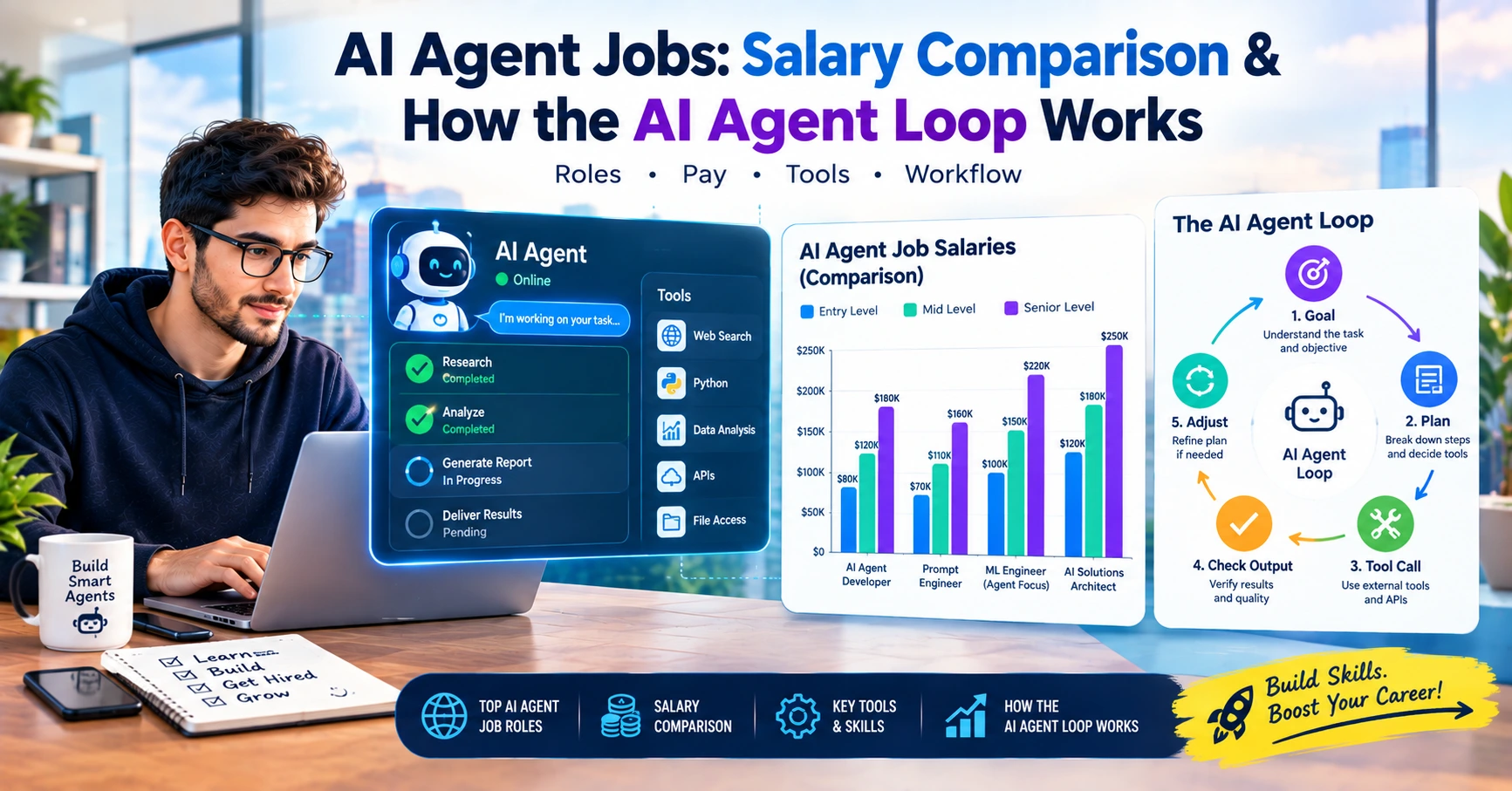
An AI agent, in the sense employers use the term, is software built on a large language model that plans a multi-step task, decides which tools or APIs to call, executes those calls, checks its own output, and adjusts if something fails, without a person re-prompting it at every step. That’s different from a standard chatbot, which answers one question and waits for the next.
Job titles built around this capability are still settling. The ones that show up most often include:
| Job Title | What the Role Typically Covers |
|---|---|
| Agentic AI Engineer / AI Agent Developer | Builds and fine-tunes autonomous agents for specific workflows |
| Forward Deployed Engineer | Embeds with enterprise customers to deploy agent systems in production |
| Multi-Agent Systems Engineer | Designs setups where several agents coordinate on one task |
| AI Automation Specialist | Connects agents to CRMs, internal APIs, and business tools |
| AI Product Manager / Strategist | Sets priorities for what an organization builds or buys |
A few titles, like product manager or strategist, lean on business judgment more than hands-on coding. Most of the rest are squarely technical.
Current Demand for AI Agent Jobs in 2026
Stanford HAI’s 2026 AI Index, drawing on Lightcast’s analysis of job postings, found AI skills now appear in 2.5% of all US job postings, up 55% from the year before and roughly 297% over the past decade. Within that broader category, “agentic AI” is the fastest-moving cluster the report tracks: postings referencing it grew about 280% year-over-year to roughly 90,000 US listings.
Two things explain why. Enterprise adoption is real: a Korn Ferry survey of 1,674 global talent leaders found 52% plan to deploy autonomous AI agents by the end of 2026, and among companies that already have, 88% are increasing their budgets and 66% report measurable productivity gains. Separately, the forward-deployed engineer, a role that works directly with enterprise clients to get agent systems running in production, saw listings rise more than 800% in 2025 after barely existing three years earlier.
The demand isn’t limited to the US. Indeed Hiring Lab’s first-quarter 2026 data put AI-related postings at 4.2% of the total in Germany, 3.3% in France, 2.7% in the UK, and 2.2% in the Netherlands, with more than half of Germany’s AI postings sitting outside traditional tech occupations. Hiring for agent-related skills increasingly happens in finance, operations, and product teams, not only in engineering.
Not every part of the software job market is expanding at the same pace. A Federal Reserve study by economists Leland Crane and Paul Soto found that US programming-job growth fell by roughly half after ChatGPT’s November 2022 launch, even accounting for the broader tech downturn, an estimated 500,000 fewer programming jobs than the pre-ChatGPT trend would predict. That’s a more commoditized layer of software work than the roles covered here, but it helps explain how contraction in one part of software employment can coexist with a reported talent shortage in agentic AI: demand is shifting toward people who build and supervise these systems, not away from technical work altogether.
What Does an AI Agent Engineer Do?
Main Responsibilities
The core of the job is building systems that reason and act, not just respond: writing the logic that lets an agent break a goal into steps, integrating the tools or APIs it needs, and building evaluation frameworks to catch cases where it goes off track. Because these systems behave probabilistically rather than deterministically, a meaningful part of the work is also building guardrails, meaning rules and checks that stop an agent from taking an unsafe or simply wrong action mid-task.
Daily Work and Projects
In practice, this looks like debugging why an agent looped on a failed API call, tuning a retrieval pipeline so it pulls the right internal documents before answering, or mapping a messy manual process into steps an agent can follow reliably. Forward-deployed roles add client-facing work: understanding a specific customer’s data and constraints well enough to adapt a general-purpose agent platform to their environment.
Skills You Need
Postings for these roles converge on a fairly consistent set of requirements:
- Python, plus hands-on experience with an agent framework such as LangGraph, CrewAI, or AutoGen
- Retrieval-augmented generation (RAG): chunking strategies, embedding models, re-ranking
- Tool calling and function orchestration, or how an agent decides what to call and in what order
- Production MLOps: deploying, monitoring, and debugging a live system, not just a notebook demo
- Evaluation and observability for non-deterministic outputs, called one of the field’s harder unsolved problems by several industry sources
- Judgment about failure modes, since agents with some independence can fail in ways a simple script cannot
- Communication skills strong enough to explain an agent’s decisions to non-technical stakeholders
Notably absent from most requirements: a PhD or research publications. Building agents is largely application engineering on top of existing models, not training new ones from scratch.
AI Agent Engineer Salary in 2026
Salary data for a job category this new is still thin, so it helps to look at it in layers rather than trust one headline number.
| Source | Scope | Reported Figure |
|---|---|---|
| U.S. Bureau of Labor Statistics (May 2024) | Software developers, broad occupation | $133,080 median; range $79,850–$211,450 |
| Robert Half 2026 Salary Guide | AI/ML Engineer, national | $134,000–$193,250; $170,750 midpoint |
| Glassdoor | “Agentic AI Engineer,” self-reported listings | $192,826 average; $152,427–$247,443 |
| ZipRecruiter | “Agentic AI” listings | $136,810 average; $94,500–$208,000 |
| Indeed | “Agentic AI” listings | $134,613 average (limited postings) |
| Real postings, Anthropic Forward Deployed Engineer (Sept 2026) | San Francisco / New York / Seattle | $280,000–$320,000 total comp |
Glassdoor flags its own agentic AI figure as based on a small, self-reported sample, and none of the platform numbers should be read as a firm offer range. A reasonable working estimate for a mainstream AI/ML or agentic engineering role in the US sits between the Robert Half figure ($134K–$193K) and the higher platform averages, with the gap explained by seniority, equity, and whether the employer is a frontier lab or a mainstream enterprise.
At the senior end, frontier labs pay well above that range. Forward-deployed engineer postings from Anthropic in September 2026 list $280,000–$320,000 in the US; earlier 2026 postings list £225,000–255,000 in London and €205,000–220,000 in Munich. These figures describe a narrow, client-facing specialization, not a typical entry point.
Who’s Hiring, and Where
Hiring clusters into three rough tiers. Frontier AI labs (Anthropic, OpenAI, Google DeepMind) pay the highest and hire the most senior, specialized profiles, including forward-deployed and agent-infrastructure roles. Agent-native companies whose products are built around agents from the ground up, such as Cursor, LangChain, and Vercel, hire aggressively for engineering roles with meaningful equity attached. A third, much larger group, spanning banks, consulting firms, healthcare systems, and established enterprise vendors, is building internal “AI transformation” teams to apply agents to existing business processes. These roles pay less than the first two tiers but represent the largest volume of openings.
By industry, activity concentrates in technology and SaaS, financial services (fraud detection, automated reporting), healthcare (documentation and diagnostic support), e-commerce (customer service agents), and enterprise IT. LinkedIn’s data places AI engineer hiring hubs in San Francisco, New York City, and Dallas, with about 26% of roles listed as remote and 27% as hybrid.
How to Get an AI Agent Job
Employers consistently favor evidence of production experience over credentials. A working system that handles real edge cases, documented on GitHub or in a portfolio, carries more weight than a certificate with no project behind it. Given how new these titles are, a candidate from traditional software engineering, data science, or even a non-technical operations background can realistically move in by building one real, not tutorial-copied, agent project and documenting the reasoning and failure-handling behind it.
Entry-level access varies by employer tier. LinkedIn’s 2026 Grad’s Guide found 75,000 of the roughly 639,000 AI-related US postings added between 2023 and 2025 were AI engineer roles, spread across technology, financial services, consulting, and defense contracting, and aimed partly at early-career candidates. At the same time, several industry reports describe new-graduate hiring tightening sharply at the most prestigious AI labs specifically. For most newcomers, the realistic path runs through mainstream enterprise adopters or agent-native startups rather than directly into a frontier lab.
Common Mistakes to Avoid
- Treating a LangChain or CrewAI tutorial as equivalent to production experience. Employers can usually tell the difference within a few interview questions about failure handling.
- Skipping evaluation and observability. Explaining how you’d measure whether a non-deterministic system is actually working is one of the more differentiating things a candidate can demonstrate.
- Applying only to frontier labs. The largest volume of real openings sits with enterprise adopters and mid-size agent-native companies, not the handful of well-known AI labs.
A Practical Example
The following is a hypothetical, illustrative scenario, not an account of a real company. A mid-size logistics firm wants to automate part of its freight-quote process, currently handled by an employee who checks rates across several carrier portals, cross-references customer contracts, and emails a quote. An AI agent engineer on this project would build an agent that logs into the relevant systems through APIs, pulls the applicable contract terms, checks them against current carrier rates, flags any quote outside a normal range for human review, and drafts the email. The initial demo might take a few days to prototype. The real engineering work is what comes after: the carrier portal that occasionally times out, the contract clause that won’t parse cleanly, and the evaluation process that catches wrong quotes before a customer sees them.
Summary
Agentic AI job postings in the US grew roughly 280% year-over-year to about 90,000 listings, per Stanford HAI’s 2026 AI Index. Pay ranges from a broad software-developer median of $133,080 (BLS, May 2024) up to $280,000–$550,000 for senior, specialized roles at frontier labs. Core skills are consistent across postings: Python, an agent framework (LangGraph, CrewAI, or AutoGen), RAG, tool orchestration, production MLOps, and evaluation for non-deterministic systems. The largest number of openings sits with enterprise adopters, not frontier AI labs, and production experience tends to outweigh certificates in hiring decisions.
Quick Questions
What is the difference between an AI engineer and an agentic AI engineer?
“AI engineer” is the broader, longer-established title and can cover model integration, fine-tuning, or general ML work. “Agentic AI engineer” specifically means building systems that plan and execute multi-step tasks autonomously, generally with frameworks like LangGraph or CrewAI. In real postings, the two titles overlap heavily.
Do I need a computer science degree for an AI agent job?
Most technical roles expect solid programming ability, typically shown through a portfolio rather than a specific degree. Adjacent roles, such as AI strategist or implementation consultant, prioritize workflow knowledge and business judgment over a formal CS background.
Are AI agent jobs available outside the United States?
Yes. Indeed Hiring Lab’s 2026 data shows meaningful AI-related hiring in Germany, France, the UK, and the Netherlands, and Stanford HAI’s index found Singapore has the highest share of AI skills in job postings worldwide. India’s hiring concentrates in hubs including Bengaluru, Noida, and Pune.
Can AI agent jobs be done remotely?
Some can. LinkedIn’s 2026 data on AI engineer roles found about 26% listed as fully remote and 27% as hybrid, meaning most still expect some in-person work, particularly at companies working directly with enterprise clients.
Is it too late to move into agentic AI in 2026?
Not based on current hiring data, though the entry point has shifted. Demand is high enough that a majority of surveyed employers report AI talent shortages, but new-graduate hiring has tightened specifically at top-tier labs. Engineers from traditional software or data roles are generally well positioned to transition by building and documenting one real agent project.
What This Means for Job Seekers
The agentic AI job market in 2026 is growing quickly by nearly every measure available, and still young enough that job titles, salary bands, and even the boundaries of the role are unsettled. That cuts both ways: genuine opportunity for people who can show working systems rather than tutorials, and a reason to treat any single salary figure or growth statistic as less precise than it looks. The more durable path into the field looks less like chasing the newest framework and more like building real production experience, wherever that happens to be hiring.
Related Articles:
Best Countries for AI Jobs With Visa Sponsorship (2026)
Remote AI Jobs for International Applicants: Top 2026 Opportunities