
Published: 13 September 2026 · Last updated: 13 September 2026 · Last reviewed against official sources: 13 September 2026
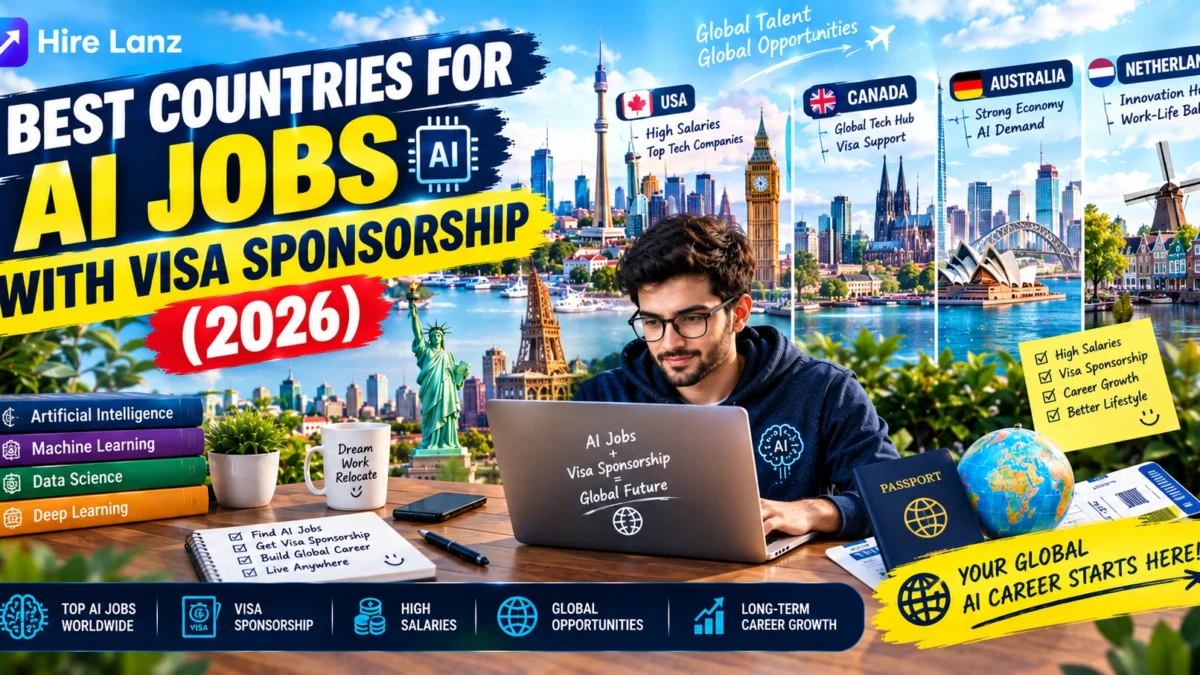
The best countries for AI jobs with visa sponsorship in 2026 are Germany, Canada, the Netherlands, and the United Kingdom. Each one has a clear, employer backed route that lets a company hire you from outside its borders and support your relocation. This guide compares those routes, the salary rules attached to each, the roles employers sponsor most, and the practical steps to win an offer. It also explains why the United States has become harder to count on this year.
What Does “AI Jobs With Visa Sponsorship” Actually Mean?
Visa sponsorship means an employer legally supports your right to work in their country. The company usually issues a formal job offer, then either applies for a work permit on your behalf or gives you the documents you need to apply yourself. Sponsorship is different from simply working remotely for a foreign company, and it is different from moving first and job hunting later.
For AI and tech roles, most countries use a “skilled worker” or “highly qualified” route. These routes reward a recognised degree or strong experience, a job that matches your skills, and a salary above a set minimum. Because AI roles tend to pay well, applicants often clear the salary bar more easily than workers in lower paid fields.
One important point up front. Rules, salary thresholds, and fees change often, sometimes every January. Treat the figures here as accurate at the time of writing in 2026, and always confirm the current numbers on the official government site before you apply.
Why AI Talent Is in Such High Demand
Demand for AI skills is not slowing down. In its Future of Jobs research, the World Economic Forum lists AI and machine learning specialists among the fastest growing roles of the decade. LinkedIn’s Jobs on the Rise report has repeatedly placed AI engineer near the top of the fastest growing jobs in the United States, and the same pattern shows up across Europe and Canada.
The shift is also visible in pay. According to PwC’s Global AI Jobs Barometer, roles that ask for AI skills have kept growing even in years when overall job postings fell, and they carry a clear wage premium over similar roles without those skills. In plain terms, employers are competing hard for people who can build and ship AI systems, and many are willing to sponsor to get them.
That competition is the whole reason visa sponsorship exists for these roles. When local supply cannot meet demand, governments open faster routes and companies use them. The countries below have built those routes deliberately.
The Best Countries for AI Jobs With Visa Sponsorship
Here are the four markets that combine strong AI hiring with a predictable, employer backed visa route.
Germany
Germany runs one of the most accessible skilled routes in Europe through the EU Blue Card. For 2026, the German Federal Ministry of the Interior set the standard minimum gross salary at 50,700 euros per year, with a lower threshold of 45,934.20 euros for shortage occupations, recent graduates, and qualifying IT specialists. These figures took effect on 1 January 2026. Most AI and software roles fall under the lower IT threshold, which makes Germany realistic for mid level engineers, not just senior staff.
Germany also lets experienced IT specialists qualify for the Blue Card without a university degree, provided they can show at least three years of relevant professional experience and meet the shortage salary level. Spouses can usually work, and the Blue Card offers one of the fastest routes to permanent residence, around 21 months with B1 level German. If you do not have an offer yet, the Opportunity Card (Chancenkarte) lets some candidates move to Germany to search for work first.
Canada
Canada is the standout choice for speed. Its Global Talent Stream is built for tech hiring, with a processing target of roughly two weeks for both the employer’s labour assessment and the worker’s work permit under the Global Skills Strategy. Category B of the stream covers common AI roles such as software engineers and data scientists that appear on the Global Talent Occupations List.
The bigger draw is what comes next. After about a year of Canadian work experience, many people become eligible for permanent residence through the Canadian Experience Class, and Express Entry now runs category based draws that favour STEM and tech workers. The main hubs are the Toronto and Waterloo corridor, the Montreal AI cluster, and British Columbia. With United States immigration in flux, Canada has actively positioned itself as the safer alternative for global tech talent.
Netherlands
The Netherlands keeps things fast and simple through its Highly Skilled Migrant (kennismigrant) scheme. There is no labour market test and no degree requirement for this route. What matters is that your employer is a recognised sponsor and that your salary meets the threshold set by the Immigration and Naturalisation Service (IND).
For 2026, the gross monthly minimum is 5,942 euros for applicants aged 30 and over, and 4,357 euros for those under 30, excluding the standard 8 percent holiday allowance. Recent graduates from Dutch or qualifying foreign universities can use a reduced figure of 3,122 euros. Many international workers also benefit from the country’s 30 percent ruling, a tax advantage for eligible newcomers. English is widely used in Dutch tech workplaces, which lowers the language barrier for newcomers.
United Kingdom
The United Kingdom remains a major AI market, though it has tightened its rules. For most new Skilled Worker applications from 22 July 2025, the general salary threshold rose to 41,700 pounds per year, or the “going rate” for the specific role, whichever is higher. Tech going rates are often higher than the general floor, for example around 49,400 pounds for software developers and near 45,100 pounds for data scientists at recent published rates. Roles now also need to sit at graduate skill level.
The UK has a second route worth knowing. The Global Talent visa is aimed at leaders and promising talent in fields including technology and research, and it does not carry a fixed salary threshold or require a standard job offer. It is more selective, but for strong AI candidates it can be a cleaner path than standard sponsorship.
Quick Comparison of the Four Routes
| Country | Main Route | Key Requirement (2026) | Speed | Path to Residence |
|---|---|---|---|---|
| Germany | EU Blue Card | From €45,934.20/yr for IT and shortage roles | Moderate | Fast, from about 21 months |
| Canada | Global Talent Stream | Prevailing wage, role on talent list | Very fast, about 2 weeks | Via Express Entry after ~1 year |
| Netherlands | Highly Skilled Migrant | From €4,357/month (under 30) | Fast | After 5 years of legal residence |
| United Kingdom | Skilled Worker | £41,700/yr or going rate | Moderate | Settlement route, longer timeline |
Figures are current at the time of writing in 2026 and can change. Confirm the latest numbers on each country’s official portal before applying.
What About the United States?
The United States still has the most AI jobs and some of the highest salaries, but its main sponsorship route has become unpredictable. In September 2025, a presidential proclamation introduced a 100,000 dollar fee on certain new H-1B petitions for workers entering from abroad. A federal court later ruled that fee unenforceable, and as of the time of writing the fee is not being collected, but the matter is still moving through appeals. Separately, the Department of Homeland Security has proposed a new rule with a similar six figure charge.
The takeaway is not that the United States is closed. It is that the H-1B path now carries real uncertainty on cost and timing, and the annual cap of 85,000 visas is decided by lottery. If your priority is a predictable move in 2026, the four countries above are easier to plan around. If your heart is set on the United States, work with an employer that has strong immigration counsel and check the current legal status before you commit.
AI Roles That Employers Sponsor Most
Sponsorship follows demand, and demand is concentrated in a handful of roles:
- Machine learning engineers who train and deploy models
- MLOps and AI platform engineers who keep systems running in production
- Applied AI and LLM engineers building RAG pipelines, evaluations, and agent based tools
- Data scientists and data engineers
- Computer vision and NLP specialists
- AI product managers with a technical background
Employers sponsor these roles because the skills are scarce and the work is hard to outsource. A strong portfolio, real deployment experience, and public work on GitHub often matter as much as the exact job title.
How to Land an AI Job With Visa Sponsorship
There is a practical order to this. Rushing the visa question before you have an offer is the most common mistake.
- Target sponsor friendly employers. Larger tech firms, well funded startups, and companies that already hire internationally are far more likely to sponsor. Many job boards let you filter for “visa sponsorship available”.
- Fix your salary math first. Check that the role’s expected pay clears the country’s threshold or going rate. If it does not, the application will fail on that ground alone.
- Build proof, not just a CV. Ship projects, contribute to open source, and write about your work. For AI roles, demonstrable systems beat buzzwords.
- Tune your CV and LinkedIn to the local market. Use the country’s expected format and keywords, and make your work authorisation situation clear.
- Apply widely and prepare for remote interviews. Expect coding tasks, system design, and applied AI questions, and account for time zones.
- Let the employer lead the visa step. Once you have an offer, the company or its lawyers handle most of the paperwork. Your job is to supply clean, accurate documents on time.
Mistakes and Scams to Avoid
The visa journey attracts bad actors, so stay alert:
- Never pay a “recruiter” or “employer” a fee to secure a job or a visa. Legitimate employers do not charge you to hire you.
- Be wary of offers that skip interviews or promise guaranteed approval. No one can guarantee a visa outcome.
- Verify the company through its official website and public records before sharing documents.
- Do not rely on outdated salary thresholds from old blog posts. Always check the current official figure.
- Avoid roles priced just below the threshold. A few thousand short can sink an otherwise strong application.
Quick Questions
Which country is easiest for AI visa sponsorship?
For speed, Canada’s Global Talent Stream is hard to beat, with a processing target of about two weeks. For accessible salary rules, Germany’s EU Blue Card and the Netherlands’ Highly Skilled Migrant scheme are strong because typical AI salaries usually clear their thresholds.
Do I need a degree to get sponsored for an AI job?
Not always. The Netherlands’ Highly Skilled Migrant route has no degree requirement, and Germany allows experienced IT specialists to use the Blue Card without a degree if they show at least three years of relevant experience. The UK and Canada place more weight on qualifications and role level.
Is the United States still worth trying in 2026?
It can be, but plan for uncertainty. The H-1B route faces ongoing legal disputes over a large new fee, and visas are capped and awarded by lottery. If a predictable timeline matters most to you, the European and Canadian routes are easier to rely on right now.
Summary
The best countries for AI jobs with visa sponsorship in 2026 all share the same logic. They know AI talent is scarce, so they built routes that let good employers hire quickly and let good candidates settle. Your practical next steps are to shortlist sponsor friendly companies in Germany, Canada, the Netherlands, or the United Kingdom, confirm that your target salary clears the current threshold, and build a portfolio that proves you can ship real systems.
Related Articles:
Remote AI Jobs for International Applicants: Top 2026 Opportunities
H-1B AI Engineer Jobs USA 2026: Ultimate Guide to High-Paying Opportunities