
The AI skills employers want on your resume in 2026 are mostly applied ones: using AI tools to do your own job better and checking what they produce. A list of tool names does little on its own. The skills that recur in hiring data are prompting and workflow design, data analysis, judgement about accuracy and risk, cross-team collaboration, and, for engineering roles, model and API implementation. Hiring managers still rank communication and problem-solving above AI. This guide covers what recent data shows, which skills to list, and how to word them. Most figures come from US or global datasets, so compare them with your own market. Data checked 21 September 2026.
What the 2026 hiring data shows
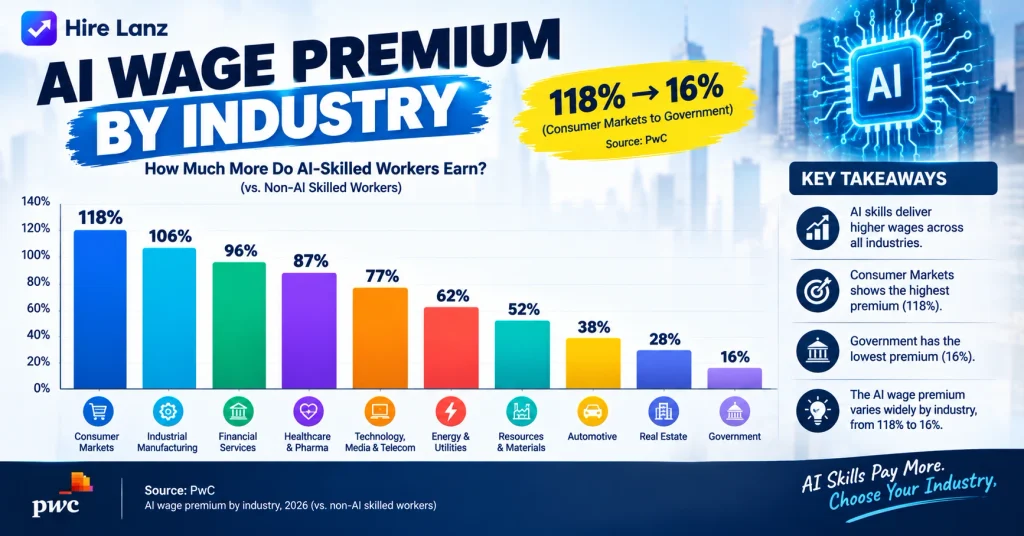
PwC’s 2026 Global AI Jobs Barometer analysed more than one billion job ads in 27 countries and territories. It found that jobs requiring specific AI skills are growing about eight times faster (69%) than the overall jobs market (9%), and that the average advertised wage premium for AI skills reached 62%, up from 57% a year earlier. The premium ranged from 118% in some consumer-market roles to 16% in government. Lightcast’s 2025 analysis of 1.3 billion postings found a smaller premium of 28%, nearly $18,000 a year. The two studies use different data and methods, and both compare advertised pay, not the offer a particular candidate will receive.
The demand reaches beyond technology teams. Lightcast reported that 51% of postings requiring AI skills in 2024 were outside IT and computer science. Indeed Hiring Lab counted 822 distinct US job titles with AI in the title in the first quarter of 2026, about 8.3% of all titles, compared with 264 in 2022. Germany had 288 such titles (4.2%) and the UK had 160 (2.7%).
Early-career applicants face a firmer expectation. In NACE’s Job Outlook 2026 Spring Update, employers said more than one-third of entry-level jobs require AI skills, nearly triple the share reported in fall 2025, and 28% said they are seeking early-career hires who can use AI in their work. The survey had 185 employer respondents, so treat it as a directional signal rather than a census.
Which AI skills to put on a resume
LinkedIn’s 2026 Skills on the Rise lists, which cover 12 markets, and Lightcast’s analysis of AI-related postings point to five groups of skills.
| Skill Area | What the Data Shows | How to Show It |
|---|---|---|
| Prompting and AI-Assisted Workflows | Prompt engineering and workflow automation appear among LinkedIn’s rising skills in several markets. | Name the task, the tool, and what changed in time, cost, or quality. |
| Data Analysis and Interpretation | Data storytelling and data analysis appear in LinkedIn’s UK and Australia lists. | Describe a decision the analysis informed and how you validated the AI output. |
| Governance, Risk and Responsible Use | Governance, risk and compliance, responsible AI, and data governance appear in LinkedIn’s lists. | State how you handled confidential data and reviewed outputs. |
| Cross-Functional Collaboration | In Lightcast’s AI-related postings, demand nearly doubled from Q2 to Q3 2025 and more than doubled from Q3 to Q4. | Say which teams you worked with to adopt or deploy a tool. |
| Technical Implementation | LinkedIn’s U.S. list includes RAG, vector databases, LangChain, fine-tuning, OpenAI API integration, and PyTorch. | List the stack and link to code or a deployed project. |
Postings rarely name tools. According to Indeed’s summary of a Hiring Lab analysis of postings from July 2024 to June 2025, nearly 74% used the general term AI and only 2% named a specific tool or model. The employer’s description of responsibilities is therefore a better guide than any tool list, so mirror the tasks it describes.
How much weight hiring managers give AI skills
Resume Genius surveyed 1,000 US hiring managers for its 2026 Hiring Insights Report. Of those, 78% called AI tool proficiency at least somewhat important, but only 19% called it very important. Asked which skills matter most when deciding who moves forward, 48% chose communication and collaboration, 46% critical thinking and problem-solving, and 42% industry or domain knowledge. AI and machine learning, including prompt engineering, was chosen by 26%.
Sixty percent said they want to test, discuss or see proof of AI ability rather than accept a resume claim. Preferences on how to show it were split: 26% preferred seeing it applied in an interview or task, 19% a brief mention on the resume, 19% work examples or outcomes, and 15% certifications or courses. Another 21% did not want candidates to emphasise AI at all. The survey covers US managers only and comes from a resume-services company, so it records stated views, not measured hiring outcomes.
Writing an AI bullet that holds up
Resume Genius respondents listed missing required skills or poor alignment with the job description (42%), lack of relevant keywords (28%) and generic or AI-heavy content (28%) among the reasons an applicant tracking system filters resumes out. That supports a short skills section using the posting’s terms, with the evidence carried by experience bullets.
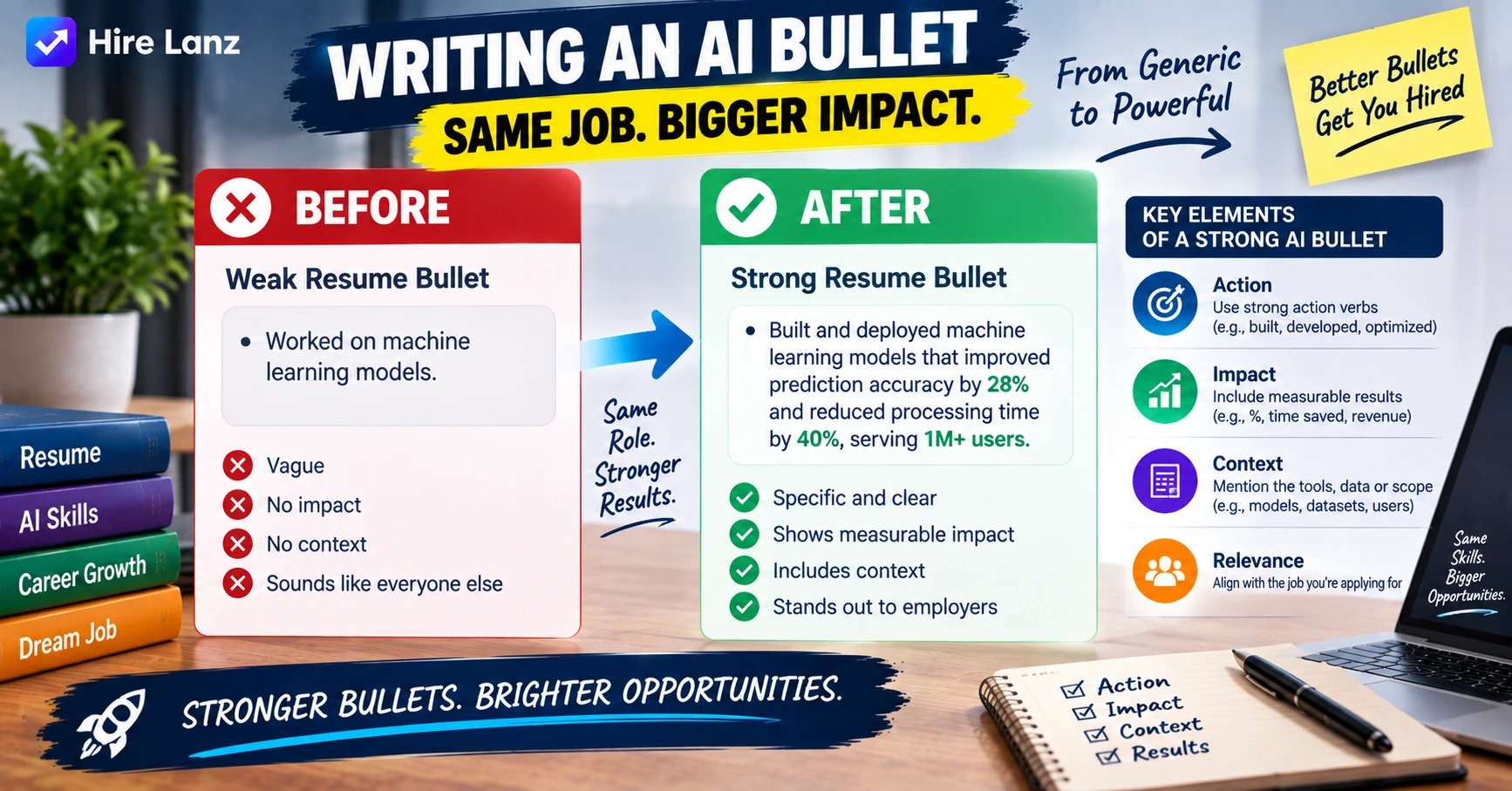
A workable bullet states the task, the tool, the result and your check on the output. This is a hypothetical example, not a real candidate; replace the figures with your own.
- Weak: Used an AI assistant for monthly reports.
- Stronger: Cut monthly sales report preparation from six hours to two by drafting summaries with an AI assistant, then checking every figure against the source spreadsheet; documented the review steps for a team of five.
Expect follow-up questions. Career coach Kyle Elliott, writing in Built In, advises preparing to explain what the work looked like before AI, why you chose the tool, where the output was wrong and how you caught it. Indeed’s career guide quotes an Indeed economist who says that explaining AI’s limits, and how you treat sensitive data, is worth doing now.
Write the bullets yourself. In the same survey, 80% of hiring managers said they can often tell when AI wrote a resume, 76% said AI-written resumes make it harder to see what a candidate actually did, and 79% said candidates should disclose AI assistance.
Common mistakes
The usual problems are listing a tool with no task or result, and claiming expertise you cannot defend in an interview, such as calling yourself a prompt engineering specialist after a few weeks of use. Copying every keyword from a posting without work to back it up carries the same risk, given that 60% of hiring managers in the survey want proof. A fourth is omitting the checking step, which leaves a bullet that describes speed and says nothing about accuracy.
Europe and other markets
In the EU, organisations that provide or use AI systems have had a duty since 2 February 2025 to take measures on staff AI literacy. Regulation (EU) 2026/1744, in force from 27 July 2026, rewrote Article 4 so that organisations must take measures to support the development of AI literacy, without guaranteeing any specific level for an individual. Because the duty sits with the employer, European interviewers may ask how you use AI at work; the text does not turn AI literacy into a personal credential. Check the Official Journal text before relying on this summary.
Most Asked Questions
Do I need to list ChatGPT or other named tools?
List a tool when you have used it for real work that matches the role. Most postings do not name tools, so the task and result carry more weight than the brand. A recruiter quoted by Indeed argues that experience with one assistant transfers to similar ones.
Are AI skills worth adding if I do not work in tech?
Where you have real examples, probably. Lightcast found more than half of AI-requiring postings sit outside IT. PwC’s premium runs from 16% in government to 118% in some consumer-market roles, so the payoff depends on sector, and 21% of surveyed hiring managers would rather not see AI emphasised.
Do certifications help?
They work best as support for real examples. In the Resume Genius survey, 15% preferred certifications or courses, compared with 26% who preferred seeing AI applied in an interview or task.
Do AI-related jobs still ask for degrees?
Often, in fields where degrees are common. Lightcast’s September 2026 analysis found that among traditionally college-educated US jobs, postings requiring AI were more likely to ask for a four-year degree than other postings, even though degree requirements in those jobs fell about 14% from 2019.
Next steps for your resume
Pick one recent task where AI changed the result, measure the before and after, and write one bullet in the structure above. Then compare your resume with two or three postings for the role you want and check that the tasks they describe appear in your wording. Several figures here come from vendor surveys and posting data that change every quarter, so recheck them if you republish.
Content You May Also Like:
AI Agent Jobs in 2026: What the Roles Actually Pay and Require