
Published: 11 August 2026 · Last updated: 28 September 2026 · Last reviewed against official sources: 28 September 2026
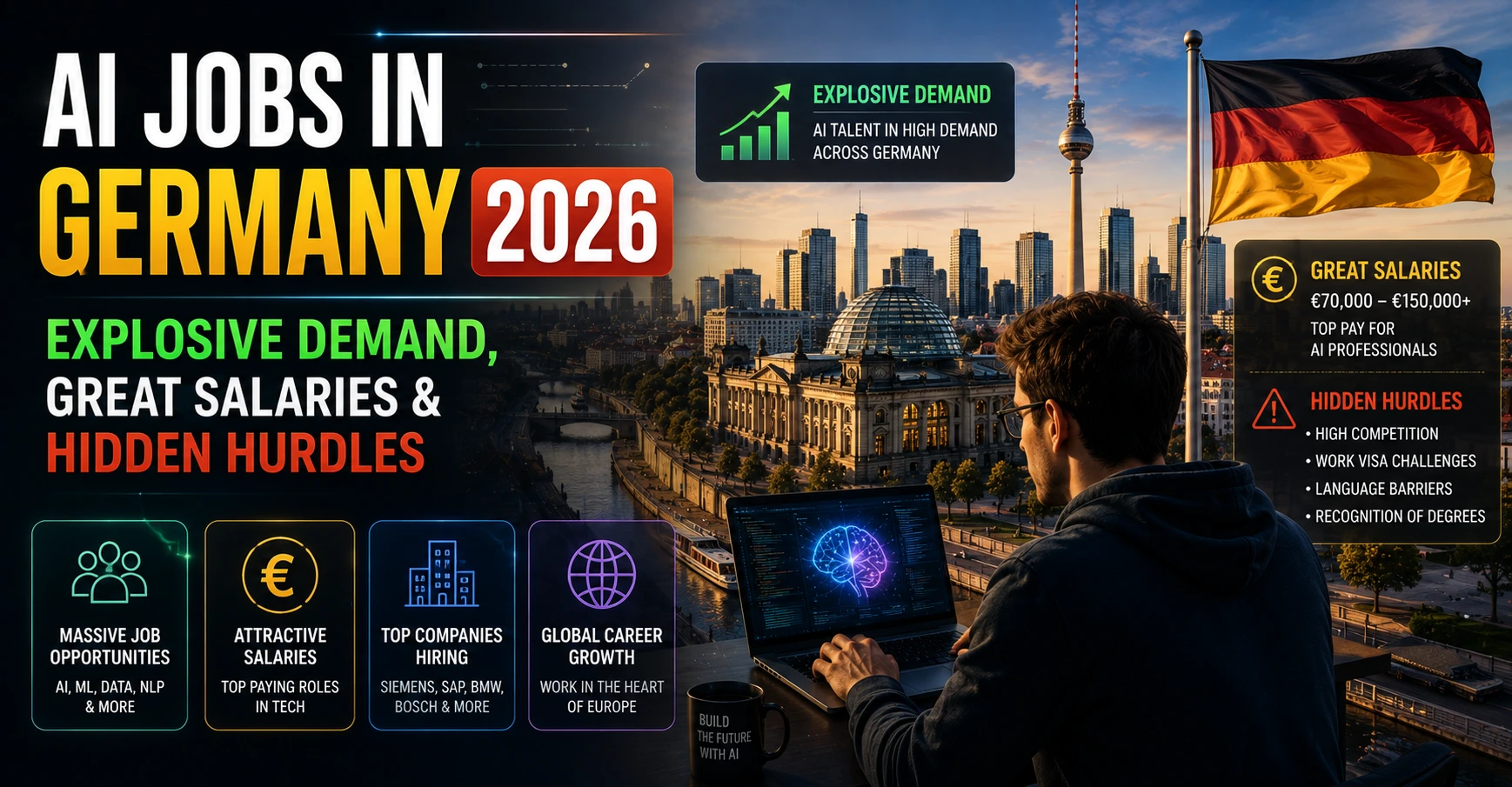
AI jobs in Germany are among the best paid technology roles in Europe right now, with typical salaries running from about €55,000 for juniors to €150,000 for specialists in areas like MLOps and large language models. Demand is real and growing. So is the competition, and the paperwork.
The Real State of AI Jobs in Germany in 2026
Germany’s AI hiring market has shifted from experimental to operational. Bitkom’s 2026 study found that 41 percent of German businesses are actively using AI, with another 48 percent planning to do so, more than double the share of active users compared to the previous year. Companies that were running pilots two years ago now need people to keep those systems running in production.
The talent gap behind those numbers is well documented. Germany faces a structural IT specialist gap of around 109,000 unfilled positions, with more than 85 percent of companies reporting insufficient IT talent and 79 percent expecting the shortage to worsen. An open IT role takes an average of 7.7 months to fill.
Here is the part competitors rarely mention. The shortage is uneven. A Bitkom survey of 850 companies found that while 42 percent of firms anticipate additional hiring driven by AI adoption, 27 percent foresee job cuts in other areas. Meanwhile, the German Economic Institute reported that open IT positions actually fell by 26.2 percent in 2024, with automotive manufacturing hit particularly hard.
The honest reading is that generic IT demand has cooled while specialised AI demand has climbed. LinkedIn’s trending roles for Germany in 2026 put Head of Artificial Intelligence at the top, with the most common skills listed as large language models, retrieval-augmented generation and MLOps, and top hiring regions being Munich, Berlin and Hamburg. Specialisation is the whole story.
What It Takes to Get Hired for AI Jobs in Germany
German employers hire differently from American ones. Credentials matter more, interviews move slower, and the final decision usually involves several stakeholders rather than one hiring manager. Expect four to six weeks between first contact and offer at a mid-sized company.
The bar has also moved. Companies no longer pay premiums for people who can train a model in a notebook. Employers are paying more for engineers who can own a model’s entire lifecycle, including training, deployment, monitoring and incident response, rather than just prototype it.
Regulation has quietly become a hiring factor too. The EU AI Act creates compliance duties that most German firms are still working out, and profiles combining AI engineering with data governance and compliance knowledge are unusually scarce. If you can talk credibly about model documentation, data lineage and risk classification, you stand out immediately.
Language is the variable nobody can answer for you. Berlin startups and international scale-ups run in English. Mid-sized industrial firms in Baden-Württemberg often do not. German at B1 or B2 will not make you a better engineer, but it will roughly double the number of employers who consider you.
What German employers consistently look for:
- Production experience, meaning models you have deployed and maintained, not just trained
- Comfort with cloud infrastructure, containers and CI/CD pipelines
- A recognised degree in a quantitative field, or documented equivalent experience
- Some evidence of working with regulated or sensitive data
AI Salaries in Germany: What the Numbers Really Say
Salary figures for AI jobs in Germany vary wildly across sources, and the reason is simple. Different platforms sample different populations. ERI SalaryExpert lists a German AI engineer average of €92,409, Levels.fyi reports a Munich metro median of €94,713, Glassdoor puts machine learning engineers at €68,000, and Stepstone lists KI-Entwickler at a median of €56,300.
Those gaps are not errors. Levels.fyi captures self-reported total compensation including equity, while Glassdoor and Stepstone capture base salary self-reports that skew lower, and Stepstone’s data leans junior because of how the job title is used in German postings.
A workable planning range looks like this. Junior AI engineers with zero to two years earn €55,000 to €70,000, mid-level engineers with three to five years earn €70,000 to €90,000, and senior engineers with five or more years earn €90,000 to €120,000, with highly specialised LLM, NLP and AI infrastructure roles reaching €150,000.
Remember these are gross figures. German income tax, solidarity surcharge and social contributions typically take 35 to 45 percent, so an €85,000 gross salary lands closer to €50,000 net for a single person in tax class I. Compare offers on net, not headline numbers.
| Experience Level | Typical Gross Salary Range | Notes |
|---|---|---|
| Junior (0–2 Years) | €55,000 – €70,000 | Often below the standard EU Blue Card threshold |
| Mid-Level (3–5 Years) | €70,000 – €90,000 | The largest segment of postings |
| Senior (5+ Years) | €90,000 – €120,000 | Munich and Frankfurt lead |
| Specialist (MLOps, LLM) | Up to €150,000 | Scarce, usually at scale-ups |
Which Cities Offer the Best AI Jobs in Germany
Munich is the highest paying market and the most enterprise-heavy. Munich consistently pays the highest base salaries for AI engineers, often 10 to 15 percent above the national baseline, driven by industrial AI demand from automotive and manufacturing giants alongside a high cost of living. It also hosts Helsing, one of Europe’s most heavily funded defence AI companies.
Berlin behaves differently. It has the widest salary distribution of any German city, with startups and international scale-ups sometimes paying top of market while smaller local firms pay well below the national average. Berlin is the easiest city to work in without German, and the easiest place to be underpaid if you do not negotiate.
Stuttgart and the wider Baden-Württemberg region are where industrial AI lives. Autonomous driving, computer vision for quality inspection and predictive maintenance dominate. Heidelberg hosts Aleph Alpha, which builds sovereign language models for governments and banks, and Black Forest Labs works on frontier image generation from Freiburg.
Frankfurt is the finance play, with banks and insurers hiring for fraud detection, risk modelling and document automation. Hamburg is smaller and pays less, but the logistics and media sectors there have real AI budgets and far less applicant competition than Berlin.
Quick city comparison for AI job seekers:
- Munich: Highest pay, most corporate, German often expected
- Berlin: Most English-friendly, widest salary spread, most competition
- Stuttgart: Industrial and automotive AI, German usually required
- Frankfurt: Finance and insurance, strong compliance focus
Visa Routes for Non-EU Applicants
The EU Blue Card is the strongest route if you already have an offer. From 1 January 2026 the regular threshold is €50,700 gross per year, while shortage occupations including IT, engineering, natural sciences and healthcare qualify at €45,934.20. Nearly all AI and software roles fall into the lower bracket.
One detail costs people their applications. The salary counting toward the threshold must be guaranteed, fixed and gross, which means performance bonuses, commissions, stock options, sign-on bonuses and housing allowances are excluded from the calculation. A €48,000 base with a €5,000 expected bonus is assessed at €48,000.
Germany also opened a route for self-taught engineers. IT specialists can qualify without a university degree if they have at least three years of relevant professional experience at academic level obtained within the last seven years. That is unusual in European residence law and worth knowing about if you switched into AI from another field.
If you have no offer yet, the Opportunity Card exists for exactly that situation. The Chancenkarte is a residence permit of up to 12 months allowing holders to work part-time up to 20 hours per week and take trial employment of up to two weeks per employer while searching . Eligibility requires a recognised qualification, German at A1 or English at B2, proof of €13,092 in funds, and a minimum of six points based on education, experience, language and age.
How to Land AI Jobs in Germany Faster
Apply where the vacancies actually sit. The Federal Employment Agency job board carries listings that never reach LinkedIn, and StepStone and Xing remain standard for German-speaking employers. Berlin startups post on LinkedIn and their own careers pages, often nowhere else.
Rewrite your CV for the German format. Reverse chronological, two pages maximum, no photo required but still common, and a clear statement of your visa status near the top. Recruiters filter aggressively on work authorisation, so leaving it ambiguous gets you skipped.
Target the Mittelstand, not just the famous names. Mid-sized manufacturers, insurers and healthcare providers are adopting AI now, have fewer applicants per posting, and often move faster than a Siemens or SAP. The trade-off is that German is usually expected.
Finally, be patient with the timeline and use it. Given the average vacancy sits open for months, a candidate who follows up thoughtfully after two weeks is remembered rather than resented. Silence in German hiring rarely means rejection.
Practical steps that shorten your search:
- Check your degree on the anabin database before applying, since recognition affects both visas
- Build one portfolio project that runs in production, with monitoring and a public write-up
- Learn German to A2 even if roles are in English, as it signals commitment to employers
- Confirm any offer meets the €45,934.20 threshold in base salary alone
- Apply to shortage-occupation roles first, since they carry the easier visa path
Frequently Asked Questions
Can I get AI jobs in Germany without speaking German?
Yes, particularly in Berlin, Hamburg and at international scale-ups where English is the working language. However, German at B1 or B2 significantly widens your options, especially with mid-sized industrial firms and public sector employers. Most job postings state the language requirement explicitly.
What salary do I need for an EU Blue Card as an AI engineer?
For 2026 you need €45,934.20 gross per year, since IT and AI roles fall under the shortage occupation category. The standard threshold for other professions is €50,700. Only guaranteed base salary counts, so bonuses and stock options are excluded.
Which German city has the most AI jobs?
Munich and Berlin lead by volume, with Munich stronger in enterprise and industrial AI and Berlin stronger in startups and scale-ups. Stuttgart dominates automotive AI, while Frankfurt concentrates on finance. Hamburg is smaller but has notably less applicant competition.
Do I need a master’s degree for AI jobs in Germany?
Not always. Many employers accept a bachelor’s degree with strong practical experience, and Germany allows IT specialists to obtain a Blue Card without any degree if they have three years of relevant experience within the last seven. Research-focused roles still typically expect a master’s or PhD.
How long does it take to find an AI job in Germany?
Plan for three to six months from first application to signed contract, longer if you are applying from outside the EU. German hiring processes involve multiple interview rounds and internal approvals. The Opportunity Card gives you a 12-month window on the ground, which materially improves response rates.
Summary
AI jobs in Germany reward specialists and test generalists. The country has a documented shortage, rising corporate adoption, salaries that compete with anywhere in Europe outside Switzerland, and two immigration routes designed specifically to bring in technical talent. Those are strong fundamentals. What separates people who land roles from people who stall is usually preparation rather than talent. Check your degree recognition early, confirm that any offer clears the visa threshold on base salary alone, build one project that demonstrates production ownership, and start German at a level that shows intent.
Related Articles: