
Your tax residency is set by each country’s own law, not by your employer’s location or your visa. If a country treats you as a resident, it can tax your worldwide income. If two countries both claim you, a tax treaty usually decides between them. The 183-day figure repeated in most guides is one test among many, and some countries use different thresholds or look at things other than days. This guide is for remote employees and contractors who work for employers outside the country where they live or travel. Rules were checked in October 2026 and change often, so treat this as general information, not tax advice.
What Tax Residency Means for Remote Workers
Tax residency is a status under a country’s tax code, separate from immigration status. Thai tax residency has nothing to do with permanent-residence visas, and someone without long-term immigration status can still meet Spain’s tax tests.
Two taxing rights are in play. The country where you are resident generally taxes your worldwide income. The country where you physically do the work may also tax pay earned there. That is why remote work does not automatically mean work you can do from anywhere without tax or payroll consequences. Which country collects, or whether both do, depends on domestic law first and treaties second.
The 183-Day Rule Covers Two Different Things
The number appears in two places. Many countries use it in their domestic residency tests. Separately, Article 15(2) of the OECD Model Tax Convention, which most bilateral treaties follow, contains an exception to the general rule that employment income is taxed in the country where the work is carried out. The exception applies only if all three conditions are met: you are present in the work country for no more than 183 days in the relevant period, your employer is not resident there, and a permanent establishment of the employer there does not bear the cost of your pay. Older treaties count the calendar year, while newer ones use any 12-month period.
For remote workers, the employer conditions often fail before the day count matters. A local entity treated as your economic employer removes the protection from the first day. The exception also covers income tax only, because income tax treaties do not deal with social security.
Residency Tests in Five Countries
These summaries show how much the tests vary. They are not complete statements of each country’s law.
| Country | Main Residency Trigger | Other Routes to Residency or Tax |
|---|---|---|
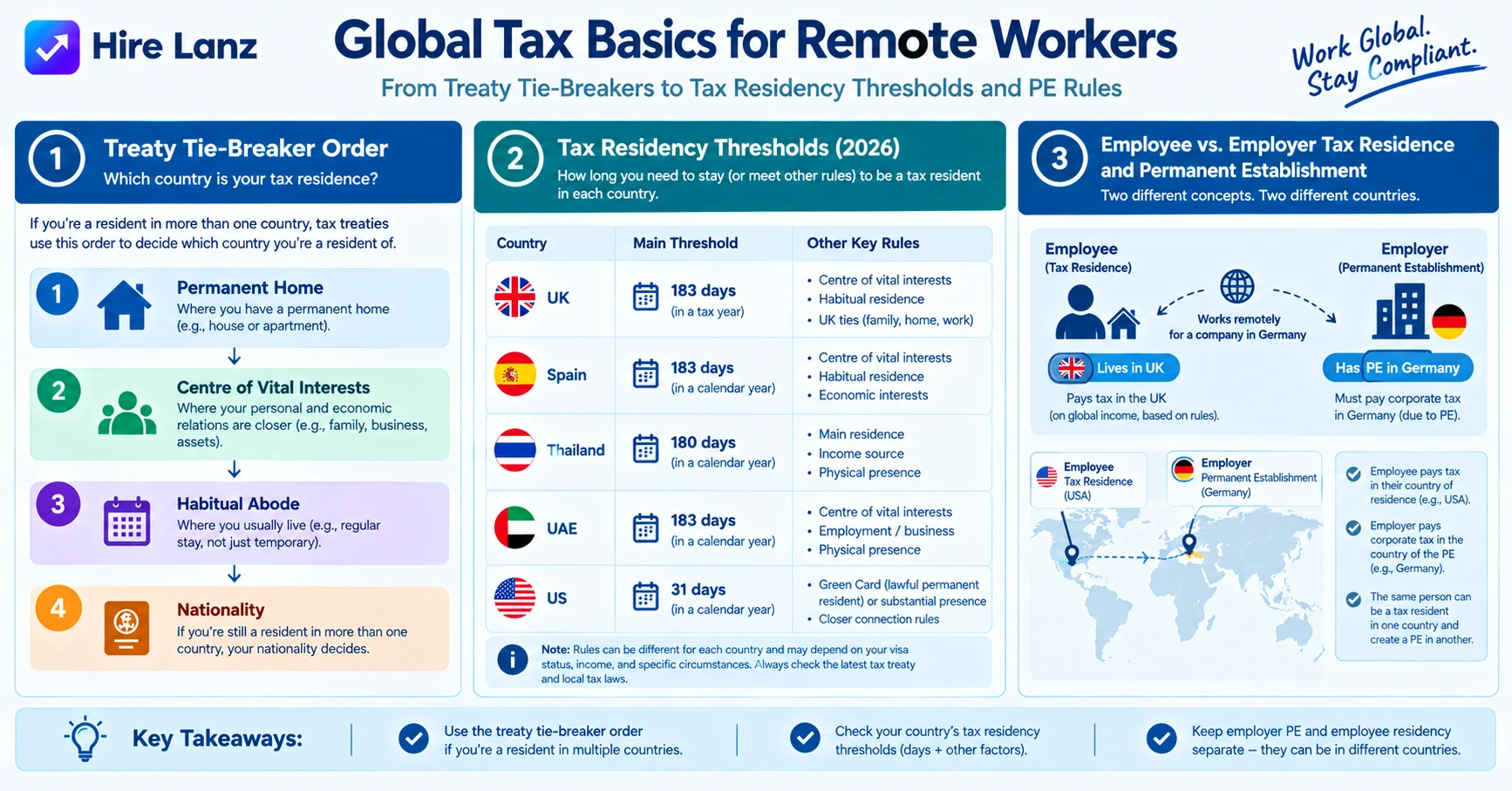
| United Kingdom | 183 or more days in a tax year, unless an automatic overseas test applies | Fewer than 16 days, or fewer than 46 if non-resident for the previous three years, makes you non-resident; in between, a test of UK ties applies |
| Spain | More than 183 days in a calendar year | Main base of activities or economic interests in Spain; residence presumed if a non-separated spouse and dependent minor children live there |
| Thailand | 180 days or more in a tax year | Foreign income earned from 1 January 2024 is taxed when remitted to Thailand, even in a later year |
| UAE | 183 days in a consecutive 12-month period | 90 days for UAE nationals, residents or GCC nationals with a permanent home, job or business in the UAE |
| United States | Citizens and resident aliens are taxed on worldwide income wherever they live |
Exclusion of up to $132,900 for 2026 if you meet the 330-day physical presence or bona fide residence test
Source |
Days are not the whole story in Spain, where the economic-interests and family tests apply whatever the day count. The US works differently because citizenship creates the filing obligation, and the exclusion applies only if a return is filed and the income is reported.
Thailand’s 2024 change affects anyone paid from abroad. Holders of the Long-Term Resident visa can qualify for a separate exemption on foreign income, and a draft proposal to relax the remittance rule was circulating in 2025, so check its current status.
How Tax Treaties Settle Dual Residency
When two countries both treat you as resident under domestic law, a treaty based on Article 4 of the OECD Model applies a sequence of tests. The first asks where you have a permanent home available.
If you have one in both countries or neither, residence goes to the country with which your personal and economic relations are closer, known as the centre of vital interests. Next comes habitual abode, meaning where you actually spend your time, and then nationality. Mutual agreement between the tax authorities is the last resort.
Treaty wording varies: the Australian Taxation Office says its treaties are modelled on Article 4(2) but contain variations. A tie-breaker also works only where a treaty is in force between the two countries.
What Your Employer’s Tax Position Means for Your Job
Your residency is half the picture. The employer may owe tax in your country if your home office counts as its permanent establishment. In November 2025 the OECD updated the commentary to its Model Convention. The new framework asks whether the employee works from the location for at least 50% of working time over a rolling 12 months, and whether the employer has a commercial reason for the work to happen there.
Arrangements driven by employee preference, retention or office-cost savings do not count as a commercial reason. Only the commentary changed, not the text of the Model Convention, and some countries, including Nigeria and Malaysia, have indicated different interpretations.
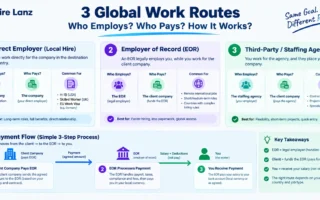
For job seekers, this explains why postings list the countries a company can hire in. An employer with no local entity may decline your location or hire you through an employer of record.
Digital Nomad Visas Do Not Decide Tax Status
A visa gives permission to stay, and sometimes to work remotely. It rarely settles tax. Thailand’s Destination Thailand Visa does not shield income from the Revenue Department, and a stay of 180 days makes you resident like anyone else. Holding Spain’s digital nomad visa does not by itself decide tax residency either. Where a tax incentive exists, it sits in separate legislation, so read that rule rather than the visa description.
Practical Example: A Hypothetical Remote Developer
The following scenario is hypothetical. A developer employed by a Canadian company leaves her home country and, in one calendar year, spends 150 days in Spain, 160 in Thailand and 55 elsewhere.
On day counts alone, neither Spain (more than 183) nor Thailand (180 or more) treats her as resident. That does not make her resident nowhere. Her home country may still treat her as resident if she keeps a home, family or main job there. Spain’s economic-interests and family tests do not depend on days. Twenty more days in Thailand would meet its 180-day test, and salary she brought into the country afterwards could be taxable. Falling between the rules is possible, but it should not be assumed.
Questions to Ask Before Accepting a Cross-Border Remote Role
Contractor status does not remove your own residency questions, since residency rules also apply to contractors and part-time workers. Before signing, ask:
- Does the company have a legal entity or employer of record in the country where I will live?
- Will tax and social security be withheld locally, or am I responsible for my own filings?
- Does the contract limit where I can work from, or for how long?
- Does the offer assume a particular visa or tax regime?
Keep a day log built from boarding passes, passport stamps and accommodation records. Authorities can ask for proof: for UAE residency, applicants present an entry and exit report from the identity authority, and the days need not be consecutive.
Most Asked Questions
Do I owe tax where I work remotely if I stay under 183 days?
Not necessarily, but you cannot assume so. Thailand’s threshold is 180 days, Spain looks at economic interests and family, and the treaty exception applies only when the employer conditions are also met. Local rules on pay for work done there can apply as well.
Can I be a tax resident of two countries at once?
Yes. Two countries can each apply their own tests. Where a treaty exists, the tie-breaker sequence decides which country counts as your residence for treaty purposes.
Does a digital nomad visa make my foreign income tax-free?
No, not automatically. The visa and the tax rules are separate, and any exemption has to come from tax legislation.
Do US citizens still file if they live abroad?
Yes. The IRS states that citizens and resident aliens are taxed on worldwide income wherever they live, and the foreign earned income exclusion applies only if you file and report the income.
What to Do Next
Before accepting a role or moving, check the residency test of your current country and your destination, then see whether a treaty links them. Confirm the employer’s setup in writing. For anything involving large sums or a long stay, a tax adviser who handles both countries is worth the cost. Verify every threshold above with the official tax authority, because several have changed in recent years.
Related Content: