
Global payroll for remote workers is the way a company pays people who live in other countries while following each country’s tax, social contribution and employment rules. An employer has three practical routes: run payroll through its own legal entity in your country, hire you through an employer of record (EOR), or engage you as an independent contractor. The route behind your offer decides who withholds your tax, which benefits the law gives you, and whose name is on your contract. This guide explains each route from the worker’s side, with notes where a small employer’s choices affect you. Figures and rules were checked on 1 October 2026.
What “global payroll” means in a job offer
The phrase is used in two ways. In the narrow sense, it describes a company paying staff through a local entity it already owns, with a vendor running the payroll calculations and filings. In that setup the company remains the legal employer and the vendor only processes the payroll. In the loose sense, it is shorthand for any cross-border pay service. Deel, for example, sells global payroll as a separate product from its EOR service: it lists global payroll at $29 per employee per month, EOR from $599, and contractor management at $49 per contractor.
An advert that says you will be “paid through global payroll” therefore does not tell you who your employer is. Ask, because the answer changes your rights.
Three ways a company can pay you across borders
The table is a map, not a legal test. Details vary by country.
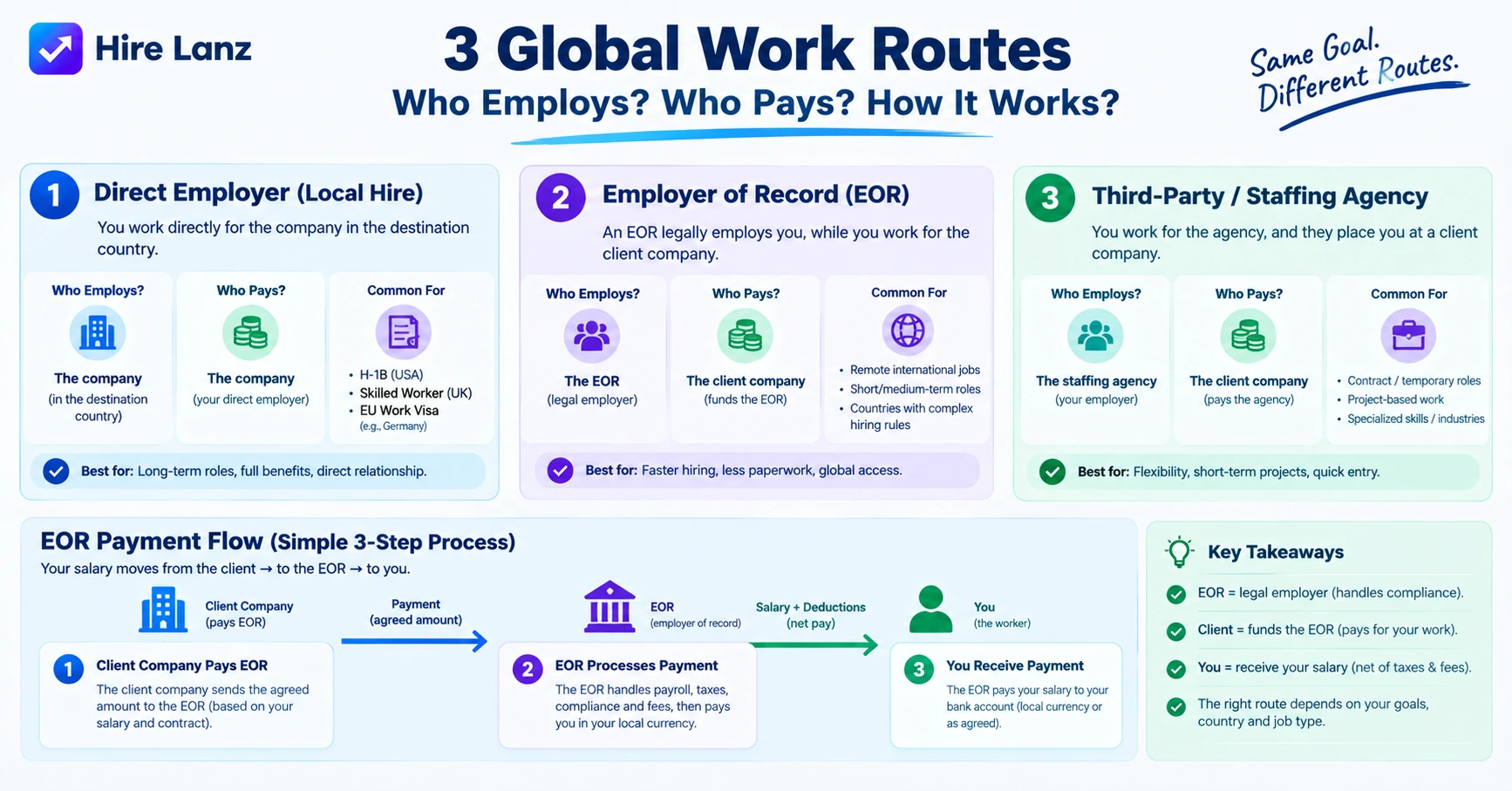
| Route | Legal Employer | Who Handles Tax Withholding | What You Usually Sign |
|---|---|---|---|
| Company’s own entity plus a payroll provider | The company’s local subsidiary or branch | The company, through the provider | A local employment contract |
| Employer of record | The EOR’s local entity | The EOR | A local employment contract naming the EOR |
| Independent contractor | You, as a self-employed person | You | A services agreement, paid against invoices |
An EOR becomes your legal employer in the country where you live, while the hiring company still assigns your tasks and judges your performance. Providers are built differently: some own a legal entity in every country they cover, and others act as intermediaries without owning local entities. That difference matters to you, because the entity named on your contract is the one that has to pay you on time and file your taxes.
Employer of record: what changes for the worker
With an EOR you sign a contract under local law, so your country’s statutory entitlements apply. Some are easy to miss when comparing salaries. More than 40 countries require some form of 13th-month pay, including Brazil, Mexico and the Philippines. In Brazil it is paid in two instalments, by 30 November and 20 December. Mexico’s minimum is lower: 15 days of salary under Article 87 of the Federal Labour Law, due by 20 December, although many Mexican employers pay 20 to 30 days.
When you compare an EOR offer with a contractor offer, check whether the quoted figure is a monthly base or an annual package that already includes these payments.
What an EOR costs, and who pays
The fee is charged to the employer, not deducted from you. A comparison of 14 provider pricing pages read on 26 September 2026 found published EOR list prices between $199 and $699 per employee per month, with $599 the most common. Deel lists $599, while Remote and Oyster list $699. Enterprise-focused providers quote privately, with reported ranges of $700 to $1,000 or more. Treat all of these as reference points, because prices change and discounts depend on billing terms.
The fee sits on top of salary and mandatory employer contributions, which differ by country. In the UK, employer National Insurance is 15% on earnings above £5,000 a year in 2026-27, and a German employee earning €5,000 a month adds roughly €1,060 in employer contributions at 21.2%. It is reasonable to infer that this stacked cost is one reason small companies sometimes prefer contractors for early hires. If you are offered contractor status for a full-time, long-term role, ask why.
The contractor route
A contractor invoices the company, manages their own taxes and social security, and generally has no statutory leave or severance from the client. Companies often like the model because it avoids local employer obligations, but a contract label does not settle the question. Taking the United States as one example, the IRS looks at behavioral control, financial control and the relationship between the parties, and a written agreement calling someone a contractor is not enough by itself. A company that treats an employee as a contractor without a reasonable basis becomes liable for employment taxes. Other countries apply their own tests, so the US factors illustrate the issue and are not a universal rule.
Some providers sell protection against this risk. Deel lists a Contractor of Record service at $325 per contractor per month, against $49 for standard contractor management.
Tax paperwork differs too. When a US company pays a contractor who lives abroad, tax-compliance providers summarizing IRS rules say that services performed entirely outside the United States are generally foreign-source income and not subject to US withholding, though the payer still needs documentation of the contractor’s foreign status. That is usually Form W-8BEN. Without a valid form, the payer may have to treat you as a US person subject to backup withholding or apply the full 30% rate for foreign persons, and any work done while physically in the US may be analyzed separately. How your home country taxes the same income is a separate question governed by local law.
Can you work from anywhere?
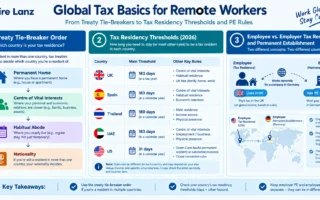
“Remote” does not automatically mean “from any country.” Where you physically work affects payroll, tax and sometimes immigration rules, and it can create corporate tax exposure for your employer. The OECD Council approved an update to its Model Tax Convention commentary on 18 November 2025. The update uses 50% of working time as a benchmark: if an employee works from a home office in a country for around half of their time or more over any rolling 12 months, that home may count as a fixed place of business for the employer.
Passing the benchmark does not automatically create a permanent establishment; it prompts a closer look at the facts. Working abroad because the employee prefers it, or because the employer wants to save on office space, is not treated as a commercial reason. Some jurisdictions have entered reservations, and some apply broader domestic definitions.
For you, the practical effect is that companies keep lists of countries where they can employ people, which is likely why some will refuse or restructure an arrangement outside those lists. If you plan to move, say so before you sign, not after.
Questions to ask before accepting an offer
- What is the legal name of my employer or client, and is that name on the contract?
- If an EOR is involved, does it own its entity in my country or work through a local partner?
- Is the salary gross, and does it include statutory extras such as 13th-month pay?
- Which currency and payment date apply, and who covers conversion fees?
- If I am a contractor, who issues the tax paperwork, and what happens if my status is reclassified later?
- Which countries can the company employ people in, and what happens if I relocate?
Be cautious if anyone asks you to pay a fee to be added to payroll, or to receive money into your account and forward part of it. Payroll providers bill the employer.
A hypothetical example
The following case is invented for illustration.
A developer in Mexico City is offered a full-time role by a US startup with no Mexican entity. Through an EOR she signs a Mexican employment contract at 30,000 MXN per month. The minimum aguinaldo on that salary is 15,000 MXN, due by 20 December, and the startup pays the EOR fee (list prices of roughly $599 to $699, per the figures above) on top of her salary. As a contractor, she would invoice the startup, submit a W-8BEN, handle her own tax filings, and receive no aguinaldo unless the contract adds a comparable bonus. Neither route is automatically better. The EOR route carries more protection, and the contractor route carries more flexibility and more responsibility. A contractor rate would need to cover the missing statutory payments and the time spent on filings.
Quick Questions
Is global payroll the same as an employer of record?
No. In the narrow sense, global payroll processes pay for employees of a company’s own local entity. An EOR instead becomes the legal employer where the company has no entity. Some vendors sell both, which is why the terms get mixed up in job ads.
Who pays the EOR’s fee?
The hiring company. Your pay is set in your contract, so the useful question is whether the quoted figure is gross and whether it includes mandatory extras such as 13th-month pay.
Does an EOR change who manages my work?
No. The company directs your daily tasks and performance. The EOR is the legal employer for contract, payroll and compliance purposes.
Conclusion
Before accepting a remote offer from a foreign company, get three things in writing: the legal name of your employer or client, whether you are an employee or a contractor, and the countries the company is permitted to employ in. Then check your own tax authority’s guidance or speak to a local accountant, because tax on foreign income depends on local law that this article does not cover. Prices and rules above were checked on 1 October 2026 and can change. The IRS and OECD pages are the places to recheck.
Related Content: