
Published: 11 August 2026 · Last updated: 27 September 2026 · Last reviewed against official sources: 27 September 2026
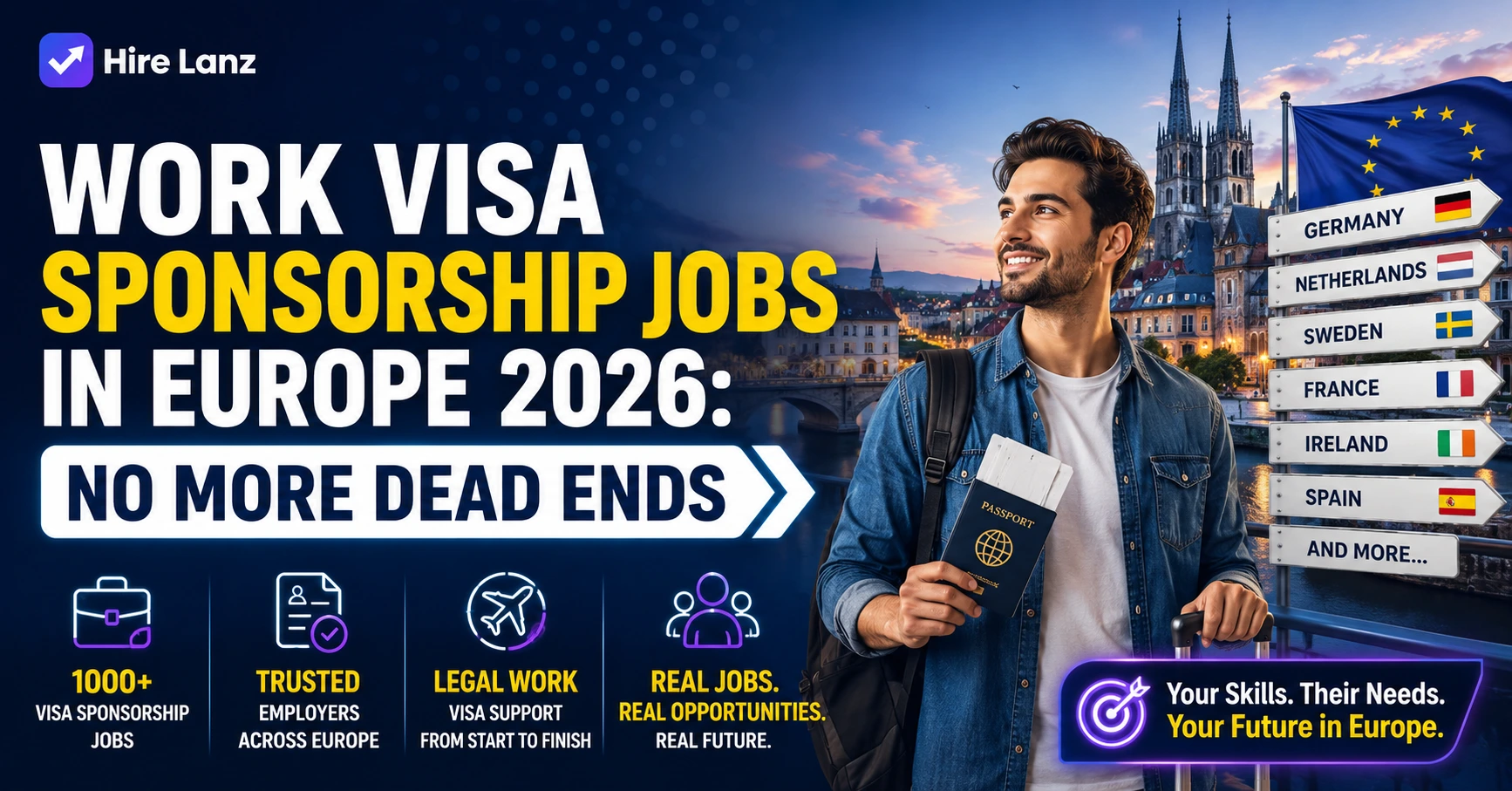
Work visa sponsorship jobs in Europe 2026 are still widely available, but only in a few countries and a few sectors. Germany, the Netherlands, Ireland, Sweden and the UK handle most non-EU hiring, mainly in healthcare, IT, engineering, construction and logistics. In nearly every case you need a job offer that clears a national salary floor. That floor runs from about €25,900 a year in Portugal to roughly €73,800 in Denmark.
What Visa Sponsorship in Europe Really Means
Sponsorship is not one system. In the UK, the employer must hold a sponsor licence and issue a Certificate of Sponsorship. In the Netherlands, an IND recognised sponsor files the application for you, and you never file it yourself.
Germany works differently again. There is no sponsor licence to check. Your contract and your qualification carry the application, which is why German job ads rarely use the word “sponsorship” at all.
The demand is real, and so is the competition. Eurostat recorded 3.5 million first residence permits across the EU in 2024, and employment was the biggest reason at 31.9%. That employment figure fell 12.2% against 2023.
Two EU-level changes landed this year. The updated Single Permit Directive had to be in national law by May 2026, and the EU Talent Pool regulation entered into force on 1 June 2026. The platform is not live yet, so you still apply country by country.
Which Countries Offer the Most Work Visa Sponsorship Jobs in Europe 2026
Germany is the clear volume leader. It accounted for roughly 78% of all EU Blue Cards issued in 2023, and about 78,100 highly qualified workers received Blue Cards across the EU in 2024. Start there if you want the widest choice of employers.
The Netherlands is the fastest system once you find the right company. More than 10,000 employers sit on the IND recognised sponsor register and get shorter processing times. The catch is a steep bar for anyone aged 30 or over.
Ireland and the UK matter if English is your only working language. Ireland’s Critical Skills Employment Permit sits at €40,904 from March 2026, and the UK’s Skilled Worker visa needs £41,700 or the going rate for the job, whichever is higher.
Then comes the cheaper tier that most guides skip. Portugal, Poland, Italy, Spain and Sweden all set floors under €42,000, which makes them realistic when your offer is modest and you mainly want a legal foothold in the bloc.
| Country | Main Route | 2026 Minimum Salary |
|---|---|---|
| Portugal | Highly Qualified Activity | €2,157/month (about €25,900/year) |
| Italy | EU Blue Card | Collective rate, around €36,300/year |
| Poland | EU Blue Card | PLN 13,355/month (about €37,200/year) |
| Sweden | Work Permit | SEK 34,470/month (about €37,400/year) |
| Ireland | Critical Skills Permit | €40,904/year |
| Spain | Blue Card / Highly Qualified | €41,356/year |
| United Kingdom | Skilled Worker Visa | £41,700/year or the applicable going rate |
| Germany | EU Blue Card | €50,700/year |
| Netherlands | Highly Skilled Migrant (30+) | €5,942/month |
| Denmark | Pay Limit Scheme | DKK 552,000/year (about €73,800) |
Four things worth pinning down before you apply anywhere:
- The threshold that counts is the one in force the day you submit, not the day you signed.
- A low threshold does not mean plenty of jobs. Check demand for your role separately.
- Denmark, Ireland and the UK sit outside the EU Blue Card scheme entirely.
- Blue Card time counts toward permanent residence and travels better across the EU.
The 2026 Salary Thresholds That Decide Your Application
Most serious rejections trace back to one number. Germany reset its Blue Card floor to €50,700 on 1 January 2026. Norway moved on 1 May, Sweden rebuilt its system on 1 June, and Spain rose to €41,356.36 at the end of June.
Countries also count salary differently, and this catches out careful applicants. Denmark counts pension contributions and holiday pay. The Netherlands excludes the mandatory 8% holiday allowance, so a Dutch offer must be around 8% larger than it first looks.
Reduced tiers are where you gain ground on work visa sponsorship jobs in Europe 2026. Germany drops to €45,934.20 for shortage occupations and recent graduates. Spain has a €33,085.09 reduced Blue Card, and Ireland allows €36,848 for graduates within a year of finishing.
Run a real example. A backend developer with a €48,000 offer clears Sweden, Poland and Germany’s shortage rate comfortably. The same offer fails the UK, where £41,700 works out near €48,850, and fails the Netherlands once the holiday allowance is stripped out.
Jobs and Sectors With Real Sponsorship in 2026
Healthcare is the strongest single sector. Nurses, doctors, care workers and allied health staff appear on shortage lists in Germany, Sweden, Ireland, Austria and the Nordics. Licensing recognition is usually the bottleneck, not the visa.
Technology remains strong, with one detail that matters enormously. Germany lets IT specialists qualify for the Blue Card with three years of relevant experience in the last seven, no degree needed. Sweden places IT technicians on its reduced tier at SEK 28,725 a month.
Engineering, construction and skilled trades are badly underrated. Electricians, welders, civil engineers and technicians are hard to fill across Germany, the Nordics and central Europe, and the green transition has pushed renewable energy engineers up several national lists.
The European Commission’s EU-wide shortage list runs to 42 occupations and stretches well past white collar work. It covers transport, hospitality, teaching, social care and agriculture, so the idea that Europe only wants software engineers is simply wrong.
The clusters where work visa sponsorship jobs in Europe 2026 are most concentrated:
- Healthcare and social care: nurses, doctors, physiotherapists, care assistants.
- Technology: software engineers, data engineers, cloud, cybersecurity, DevOps.
- Engineering and trades: civil and mechanical engineers, electricians, welders, technicians.
- Transport and hospitality: drivers, warehouse supervisors, chefs, hotel staff.
How to Find Employers That Actually Sponsor
For the UK, use the government’s register of licensed sponsors. Only companies on that list can issue a Certificate of Sponsorship, so filtering your applications against it removes weeks of dead-end interviews.
For the Netherlands, the IND publishes its recognised sponsor register and refreshes it monthly. The version current at the time of writing was updated on 3 August 2026. If a company is not listed, it cannot hire you as a highly skilled migrant.
Germany has no equivalent register, which changes your tactics for work visa sponsorship jobs in Europe 2026. Target employers with existing international teams, use the official Make it in Germany portal and the Federal Employment Agency job board, and treat English-language ads in Berlin, Munich and Hamburg as a strong signal.
Read a licence as capability, not intent. A listed company can sponsor, but that does not mean it is hiring from abroad this quarter. And no legitimate European employer charges you for a job offer or a work permit.
Routes That Do Not Need a Job Offer First
Germany’s Opportunity Card, the Chancenkarte, is the most flexible entry route in Europe right now. It gives you up to 12 months to job hunt on the ground. You need a recognised qualification or six points on its grid, plus German A1 or English B2 and about €13,092 in funds.
While you hold it you can work part-time up to 20 hours a week, and take trial employment of up to two weeks per employer with no cap on the number of trials. Once you sign a qualifying full-time offer, you convert the card into a Blue Card or skilled worker permit.
Austria runs a comparable Job Seeker Visa with no salary requirement. It asks for 70 points out of 100 and gives you six months in the country, which suits candidates scoring well on age, qualifications and language.
One warning saves a lot of heartache when you chase work visa sponsorship jobs in Europe 2026 this way. A job seeker visa is not a work visa. It buys time and access only, and if the conversion does not happen inside the window, you leave.
Before committing to a job seeker route, confirm these five things:
- Your qualification status, checked against the country’s official recognition database.
- Your points score, calculated honestly rather than optimistically.
- Proof of funds in the exact form the consulate accepts, such as a blocked account.
- Whether your profession is regulated and needs a separate licence.
- A target list of employers built before you fly, not after you land.
Summary
Work visa sponsorship jobs in Europe 2026 come down to three questions. Can this employer legally sponsor, does my offer clear the 2026 threshold, and is my occupation on a shortage list that lowers it? Germany offers the widest choice and the most side doors, the Netherlands the fastest process, and Portugal, Poland and Sweden the lowest bars.
Frequently Asked Questions
Which country has the most work visa sponsorship jobs in Europe 2026?
Germany offers the widest range of routes, including a Blue Card path for IT specialists without a degree. Judging purely on salary floors, Portugal, Poland and Sweden set the lowest bars among mainstream destinations.
Can I get a European work visa without a university degree?
Yes, in several places. Sweden’s work permit has no degree requirement at all. Germany’s experience route accepts two years of relevant work in the last five, and its Blue Card accepts three years of IT experience instead of a degree.
Do I need a job offer before applying?
Usually yes, but not always. Germany’s Opportunity Card and Austria’s Job Seeker Visa both let qualified applicants enter first and search on the ground, then convert to a work permit once a suitable offer is signed.
How do I check if a company can sponsor my visa?
Use the official registers. The UK publishes a register of licensed sponsors, and the Netherlands publishes an IND recognised sponsor register updated monthly. Germany has no register, so look for employers with international teams.
Do bonuses and holiday pay count toward the threshold?
It depends on the country. Denmark counts pension contributions and holiday pay, the Netherlands explicitly excludes the 8% holiday allowance, and Austria excludes the 13th and 14th salaries. Check the official page for your target country.
How long does permanent residence take?
Germany’s Blue Card is quickest at 21 months with B1 German, or 27 months with A1. The Netherlands and Ireland both take roughly five years, and Sweden is typically four years.
Conclusion
Landing work visa sponsorship jobs in Europe 2026 is a matching problem, not a luck problem. Pick two or three countries where your salary clears the bar, check whether a reduced tier applies to your occupation, age or graduation date, then apply only to employers that can legally sponsor you. Confirm each figure on the official source the day you submit. If your offer is still short, Germany’s Opportunity Card buys you 12 months to close the gap from inside the country.
Related Articles: