
Published: 5 August 2026 · Last updated: 5 September 2026 · Last reviewed against official sources: 5 September 2026
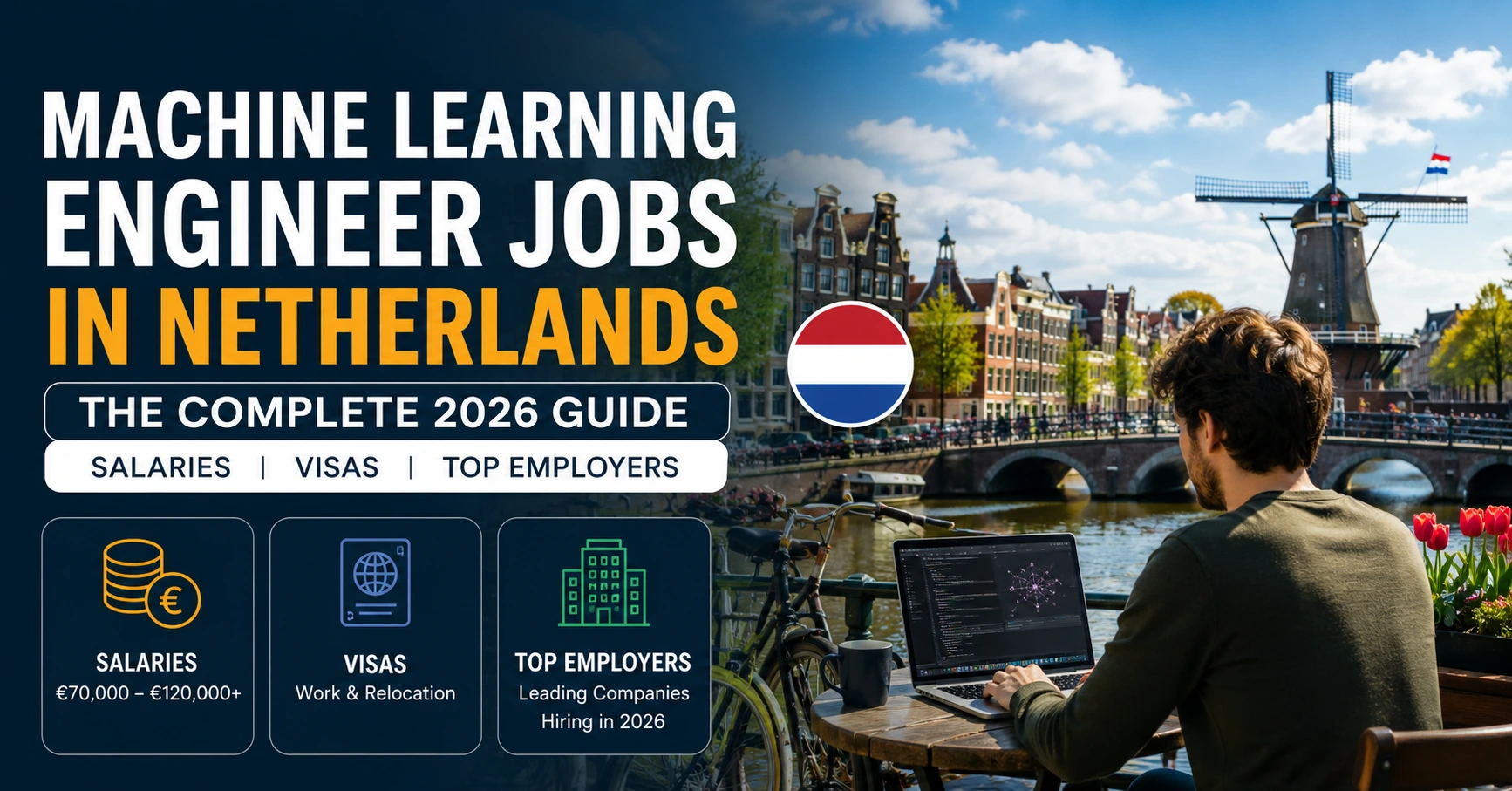
Machine learning engineer jobs in Netherlands pay roughly €58,000 to €116,000 gross per year in 2026, with the typical mid level role near €78,000. If you are coming from outside the EU, your offer must clear the highly skilled migrant threshold of €5,942 gross per month at age 30 or over, or €4,357 under 30. Most openings sit in Amsterdam and the Eindhoven Brainport region, and nearly all run in English.
Why Dutch Companies Keep Hiring ML Engineers
The Netherlands built its AI ecosystem before the hype cycle arrived. TU Delft, Eindhoven University of Technology and the University of Amsterdam have run strong research groups for decades, and several market analyses now place the country at Europe’s highest relative density of AI specialists.
Demand is just as tight. Statistics Netherlands reported over 381,000 open vacancies in late 2025, with IT among the sectors that cannot fill roles domestically. When vacancies outnumber unemployed workers, employers stop debating whether to sponsor.
Language keeps the door open. Over 90 percent of the population speaks English, and in tech teams it is usually the official working language. You can build a full career in Amsterdam without writing a line of Dutch, which is not true in France or Spain.
There is also a regulatory pull. The EU AI Act pushed European firms toward documented, auditable machine learning, and Dutch employers lean into it. Job ads here ask for engineers who ship models that are explainable and GDPR compliant, not just accurate.
What Machine Learning Engineers Earn in the Netherlands
Salary data here is messy, and you should know that before negotiating. Glassdoor puts the national average near €77,762 from 211 self reported salaries as of June 2026, with a band of €58,525 to €96,000 and top earners near €116,000. ERI reports €89,633. Payscale reports under €50,000.
These are differently weighted, not contradictory. Payscale skews toward juniors and non tech industries, ERI toward large corporate employers. Glassdoor sits in the middle and is the most realistic anchor for an international tech candidate.
The more useful pattern is the premium. AI and ML roles here command roughly 12 to 25 percent more than comparable software engineering positions. Senior engineers commonly land €85,000 to €120,000 base, with total compensation running 20 to 50 percent higher at top employers.
One warning about Amsterdam. The city pays roughly 28 percent above the national median, but housing has risen faster than pay. An €85,000 offer in Eindhoven can leave you better off than €95,000 in Amsterdam once rent is paid.
Quick reference points for 2026:
- Junior or graduate: roughly €45,000 to €62,000
- Mid level, three to five years: roughly €70,000 to €90,000
- Senior: roughly €85,000 to €120,000 base
- Staff or principal: €130,000 and above, with top packages at trading firms and large platforms reported near €185,000
| Experience Level | Typical Base Salary (Gross/Year) | Meets Highly Skilled Migrant (30+) Salary Requirement? |
|---|---|---|
| Graduate | €45,000 – €62,000 | Only via reduced post-study route |
| Mid Level | €70,000 – €90,000 | ✔ Yes |
| Senior | €85,000 – €120,000 | ✔ Yes |
| Lead / Principal | €130,000+ | ✔ Yes |
Visa Routes for Non-EU Candidates
The main route is the Highly Skilled Migrant permit, locally the kennismigrant. Your employer must be a recognised sponsor registered with the immigration service (IND), and your gross monthly salary must meet the 2026 threshold: €5,942 at 30 and over, or €4,357 under 30. Both exclude the 8 percent holiday allowance, which catches candidates out.
A reduced threshold of €3,122 per month applies to graduates converting from a Dutch orientation year. This is the most practical entry point for early career engineers, because a €40,000 first job can sponsor you where a direct hire from abroad could not.
The zoekjaar, or orientation year, gives graduates of Dutch universities and designated top 200 global universities twelve months of unrestricted labour market access. No job offer, sponsor or salary threshold applies. Fees run around €220, and you must apply within three years of graduating.
Then there is tax. The 30 percent ruling lets qualifying international hires take up to 30 percent of salary tax free for five years, and 2026 is the last year at the full rate. From January 2027 it drops to 27 percent and the salary standard rises to €50,436.
Skills Dutch Employers Actually Test
The recurring stack is Python, SQL, Docker, Kubernetes and one cloud platform, usually Azure or GCP. Deep learning frameworks appear, but so do CI/CD pipelines and model monitoring.
This gap costs candidates offers. Someone who can fine tune a transformer but has never deployed a model, watched it drift and rolled it back loses to a weaker modeller with stronger operations. MLOps is the baseline here, not a specialisation.
Communication carries unusual weight. Dutch workplace culture is direct and flat, and ads ask for people who can explain trade offs to non technical stakeholders. You will be pushed back on in interviews, and disagreeing with reasons scores better than agreeing politely.
Specialisation raises your ceiling. Large language model engineering, computer vision for industrial systems and AI for drug discovery all command premium pay here.
Four things worth building before you apply:
- One deployed project with monitoring, not five notebooks
- Working knowledge of Kubernetes and at least one cloud platform
- A clear story about a model that failed and what you changed
- Basic literacy in GDPR and EU AI Act obligations for your domain
Where the Jobs Are: Cities and Employers
Amsterdam holds the largest concentration. In mid 2026 Glassdoor listed around 770 machine learning roles nationally, roughly 387 in Amsterdam. Employers mix global platforms with Dutch scale ups: Booking.com, Adyen, ING, Picnic, TomTom and Prosus all run substantial ML teams.
Eindhoven is the second hub and a different market. The Brainport region is built around high tech manufacturing, anchored by ASML, NXP and Philips. Work leans toward computer vision, sensor data and anomaly detection. Salaries look lower on paper, but living costs favour Eindhoven.
Utrecht, Rotterdam and Delft form a third tier. Utrecht has health tech and consultancy work, Rotterdam skews toward logistics and port optimisation, Delft toward university spinouts. These cities see less applicant competition, which matters more than most job seekers expect.
Do not overlook consultancies. Firms like Sogeti, Xebia and Amsterdam Data Collective hire ML engineers continuously and often sponsor visas. The work is project based and varied, but it is a realistic first Dutch job.
How to Apply and Actually Get Hired
Start with the IND public register of recognised sponsors. It lists every company legally able to sponsor a highly skilled migrant, saving weeks of applying to firms that could never hire you. Cross reference it against LinkedIn, Indeed NL and career pages.
Be explicit about your status in the first line. If you hold an orientation year permit, say so plainly: free labour market access, no sponsorship needed. Recruiters reject international CVs out of uncertainty rather than policy, and one sentence removes that.
Expect a slower process. Dutch hiring commonly runs four to eight weeks across a recruiter screen, technical assessment, system design conversation and culture round. Ghosting is a frequent complaint, so keep several processes running in parallel.
Set expectations honestly. Recent graduates report a tighter market than the 2021 boom, more non tech roles asking for Dutch, and heavy junior competition. If you are eight months into an orientation year without a pipeline, reassess rather than wait.
Summary
Machine learning engineer jobs in Netherlands combine strong pay, English speaking workplaces and a workable immigration path. Salaries run from roughly €45,000 for graduates to €120,000 and beyond for seniors, an AI premium of 12 to 25 percent over general software roles. Non-EU candidates need a recognised sponsor and a salary above €5,942 monthly at 30 or over, or €4,357 under 30, with a reduced €3,122 graduate route.
Most Asked Questions
Do I need to speak Dutch to work as a machine learning engineer in the Netherlands?
Generally no. Tech teams at product companies and scale ups operate in English, and over 90 percent of the population speaks it well. Dutch matters more in government and healthcare, but it rarely blocks a tech hire.
How much does a machine learning engineer earn in the Netherlands?
Glassdoor reports a national average near €77,762 as of mid 2026, with a typical range of €58,525 to €96,000 and top earners around €116,000. ERI reports €89,633. Seniors commonly earn €85,000 to €120,000 base.
Can I move to the Netherlands as an ML engineer without a job offer?
Only through the orientation year permit, which requires a degree from a Dutch institution or designated top 200 global university, applied for within three years of graduating. It grants twelve months of unrestricted work access. Otherwise you need a sponsored offer.
Is the 30 percent ruling being abolished?
No. Proposals to scrap it were defeated and the earlier taper was cancelled. The rate holds at 30 percent through 2026 and becomes a flat 27 percent from January 2027, with a five year maximum duration.
Are junior machine learning jobs realistic for foreigners?
They are harder than mid level roles. Junior salaries often fall below the standard visa threshold, which is why the reduced €3,122 graduate route matters. If you did not study in Europe, targeting mid level roles is usually faster.
Conclusion
Machine learning engineer jobs in Netherlands remain one of the more accessible high paying tech routes in Europe, but the market rewards preparation over enthusiasm. The candidates who succeed check the sponsor register first, point to a model running in production rather than a folder of notebooks, and know that €95,000 in Amsterdam and €85,000 in Eindhoven can leave them equally well off.
Sources: Dutch Immigration and Naturalisation Service (IND) 2026 salary thresholds via LIMES International, Grant Thornton and Deloitte Netherlands; Business.gov.nl and PwC Netherlands on the expat ruling; Glassdoor, ERI and Payscale salary data (June 2026); Statistics Netherlands (CBS) vacancy data.
Related Content: