
Published: 1 September 2026 · Last updated: 27 September 2026 · Last reviewed against official sources: 27 September 2026
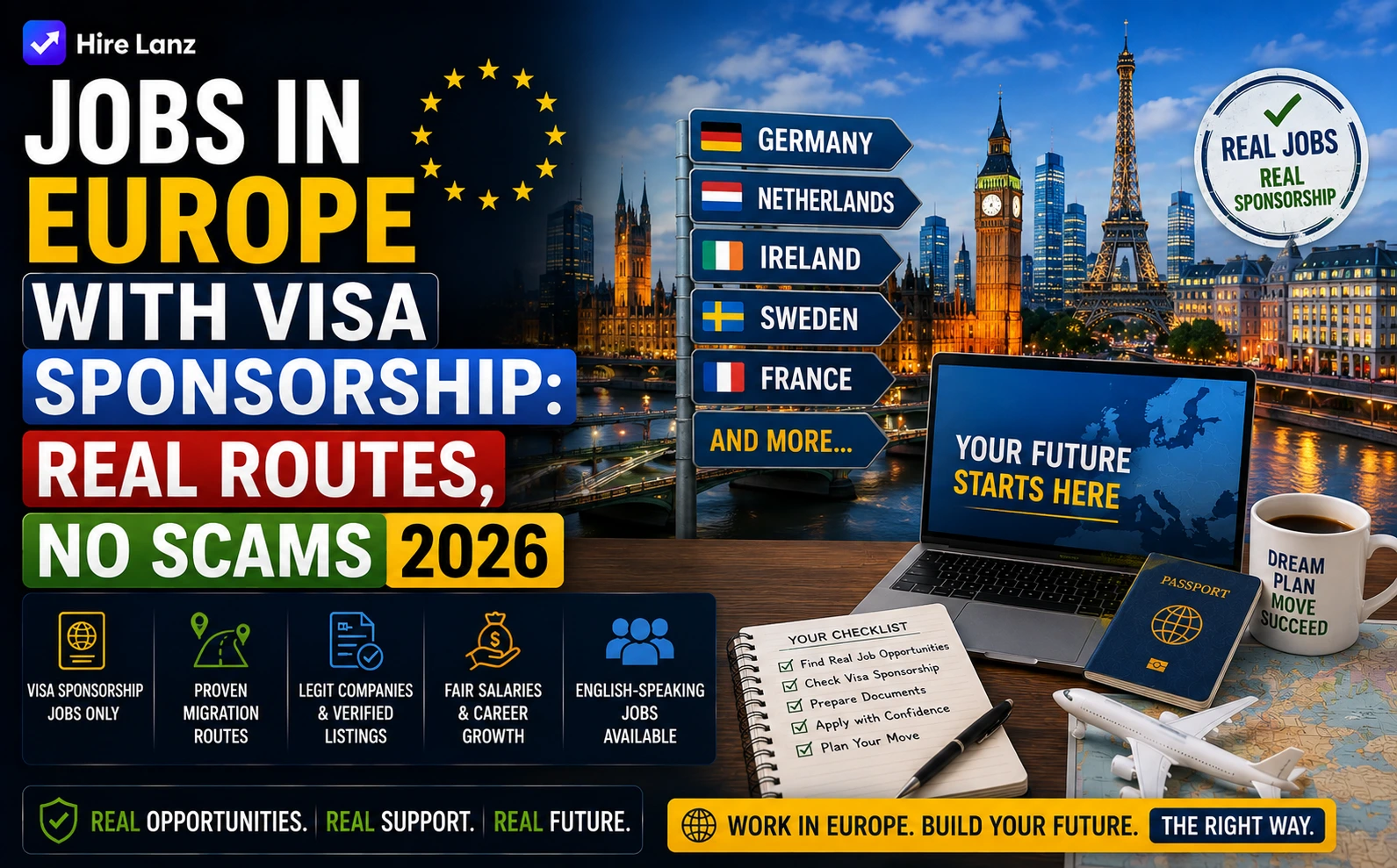
Jobs in Europe with visa sponsorship are real, but they work differently from what most job boards suggest. There is no single European sponsorship licence. Each country runs its own work permit, and a qualifying job offer is what unlocks it. The closest thing to a shared route is the EU Blue Card, which produced 78,096 permits across the EU in 2024, with Germany issuing 72% of them.
What Visa Sponsorship Actually Means in Europe
In most of Europe, sponsorship means an employer offers you a qualifying role and a permit is issued that ties your residence to that job. The Netherlands formalises this through a recognised sponsor register. Germany relies instead on a signed contract, a salary floor and recognition of your qualification.
The EU Blue Card is the nearest thing to a common route. In 2024 the EU issued 78,096 of them, down from 89,055 in 2023 after the directive was revised. Germany accounted for 56,252, followed by Poland with 5,853, Hungary with 2,942 and France with 2,775. Indian nationals received about 21% of the total.
Employers sponsor because they cannot fill the role locally. Ireland states this openly: its policy sources skills from Ireland and the wider EEA first, and permits target skills normal recruitment cannot supply. That is why occupation lists matter more than enthusiasm.
It also explains what sponsorship is not. You cannot buy it. In most destination countries the employer carries recruitment and permit costs, and charging a worker for a job is either illegal or a clear sign the offer is fake.
Jobs in Europe With Visa Sponsorship: Permits and 2026 Salary Thresholds
Germany is the largest single market for jobs in Europe with visa sponsorship. From 1 January 2026 the EU Blue Card requires a gross annual salary of €50,700, or €45,934.20 for shortage occupations, recent graduates and IT specialists who qualify through experience rather than a degree.
The Netherlands runs its Highly Skilled Migrant route through recognised sponsors, with no labour market test. For 2026 the IND requires €5,942 gross per month for applicants aged 30 and over, €4,357 for those under 30, and €3,122 under the reduced criterion for qualifying graduates. Holiday allowance sits on top of those figures.
Ireland raised its thresholds on 1 March 2026. A Critical Skills Employment Permit now needs €40,904 for a listed occupation with a relevant degree, €36,848 for recent graduates of Irish institutions, or €68,911 for roles outside the list. General Employment Permits moved to €36,605. Further rises are already scheduled through 2030.
Poland, Hungary, France and Spain issue smaller Blue Card volumes but still hire through national permits, and countries issuing almost no Blue Cards may sponsor under their own schemes. Check the national route before assuming a country is closed to you.
| Country | Main Route | 2026 Threshold | Worth Knowing |
|---|---|---|---|
| Germany | EU Blue Card | €50,700, or €45,934.20 shortage | Largest issuer by far |
| Netherlands | Highly Skilled Migrant | €5,942/month, €4,357 under 30 | Recognised sponsors only |
| Ireland | Critical Skills Permit | €40,904 listed occupations | English language, spouse work rights |
| Poland | National Permit and Blue Card | Varies by role | Second largest Blue Card issuer |
Three quick rules before you apply anywhere:
- Match the occupation list first, then the salary, then the paperwork.
- Treat every threshold as gross base pay, not total package.
- Confirm the figure in force on your application date, since several countries index annually.
Which Jobs Get Sponsored Most Often
The 2025 EURES report on labour shortages recorded 2,617 shortage occupations across participating countries, with 57% rated medium or high severity. Shortages cluster among professionals, skilled trades and machine operators, so most jobs in Europe with visa sponsorship sit well outside the software-only picture other articles paint.
Health and care is the sharpest pressure point. The sector employs around 25 million people in Europe and faces persistent gaps in doctors, nurses and care workers, which is why nursing appears on shortage lists year after year.
Trades are the quiet opportunity. Welders, electricians, plumbers, carpenters and lorry drivers have ranked near the top of European shortage lists repeatedly, and these roles usually route through national permits rather than the Blue Card.
One finding should change how you target countries. Almost every occupation short in one country is in surplus in another, and shortages concentrate in a handful of states. Applying to the wrong country with the right skill wastes months.
How to Apply Without Wasting Months
Start with recognition, not applications. Germany assesses foreign degrees through the anabin database, and Ireland requires a relevant degree for most Critical Skills roles. An unrecognised qualification stalls an otherwise strong application.
Then check your target country’s occupation list and confirm your expected salary clears the threshold with room to spare. Offers priced at the floor turn risky when thresholds rise, as they did in Germany and Ireland this year.
Apply where sponsors actually are. Official portals such as EURES, Make it in Germany and the Dutch recognised sponsor register list employers already offering jobs in Europe with visa sponsorship, which beats mass-applying on general job boards.
Build the paperwork before you need it. Certified translations, apostilles and reference letters take weeks, and permit decisions add more. Preparing documents alongside applications is what separates a three-month process from a nine-month one.
- Verify qualification recognition in your target country.
- Confirm your occupation appears on the relevant list.
- Apply through recognised sponsors and official portals.
- Prepare translations and apostilles early.
Routes for People With No Job Offer Yet
Not all jobs in Europe with visa sponsorship begin with an offer sent from abroad. Germany’s Opportunity Card, or Chancenkarte, exists for exactly this situation. Introduced under Section 20a of the Residence Act in June 2024, it grants up to 12 months in Germany to search for qualified work, with part-time work of up to 20 hours per week and two-week trial periods with prospective employers.
Eligibility runs on two tracks. If your degree or vocational qualification is fully recognised in Germany, you skip the points test. If it is not, you need at least six points from qualifications, recent experience, language ability, age and previous stays in Germany.
Baseline requirements apply either way. You need German at A1 or English at B2, plus proof of around €1,091 per month, roughly €13,092 for the year, usually in a blocked account. The visa fee is modest, but that account is a real financial hurdle.
The card is a bridge, not a destination. Once you secure a qualified full-time role you convert to a skilled worker permit or an EU Blue Card. Family reunification is generally restricted until then, which matters if you are moving with dependants.
Red Flags, Real Costs and Honest Trade-offs
The most reliable rule for anyone chasing jobs in Europe with visa sponsorship is simple: legitimate employers never charge you for a job, a visa or a permit. Under fair recruitment principles and the laws of most destination countries, recruitment costs sit with the employer. Any request to pay an employer for sponsorship is fraudulent.
Verify before you engage. Check the company registration, expect a domain-based email rather than a free account, insist on a video interview, and compare the offered salary against normal pay for the role. Unskilled work advertising senior pay is the oldest trick in the file.
Some costs are legitimately yours. Translations, apostilles, courier fees, the visa fee, a blocked account where required, flights and your first months of rent all come out of your pocket. Budget for them honestly.
Then weigh the trade-offs. Language requirements bite harder than candidates expect outside Ireland, housing in Amsterdam, Dublin and Munich is severely tight, and thresholds rise annually, so recheck this year’s numbers before you apply.
- Never pay an employer or agent for a job offer.
- Refuse payment by crypto, wire transfer to a personal account or untraceable services.
- Walk away from urgency tactics and 24-hour deadlines.
- Distrust offers made without any interview.
- Check every claim against an official government portal.
Summary
Jobs in Europe with visa sponsorship are employer-led, country-specific and concentrated. Germany dominates Blue Card volumes, the Netherlands runs a fast recognised-sponsor route, and Ireland offers an English-speaking path with strong family rights. Shortages are real but unevenly spread, so country choice matters as much as skill. Verify thresholds on your application date and never pay for an offer.
Frequently Asked Questions
Which country offers the most jobs in Europe with visa sponsorship?
Germany, by a wide margin, since it issued 72% of all EU Blue Cards in 2024 and also runs the Opportunity Card for job seekers. Ireland suits English speakers well. The right choice depends on your occupation, salary and language ability.
Can I get sponsored without a university degree?
Yes, in some cases. Germany allows IT specialists with roughly three years of recent relevant experience to qualify for the Blue Card at the lower threshold, and many skilled trades are sponsored through national permits instead.
How much salary do I need for a European work permit in 2026?
It varies by country. Germany requires €50,700, or €45,934.20 for shortage occupations. The Netherlands requires €5,942 gross per month at age 30 and over. Ireland requires €40,904 for listed Critical Skills roles from 1 March 2026.
Do I have to speak the local language?
Not always, but it helps. Ireland works in English, and Germany’s Opportunity Card accepts English at B2 instead of German. In practice, local language ability widens the pool of employers willing to hire you.
How long does the process usually take?
Plan for several months end to end. Recognition, translations and consular appointments each add time, and permit decisions vary by country and season. Starting paperwork before you hold an offer is the single biggest time saver.
Conclusion
Jobs in Europe with visa sponsorship reward preparation far more than volume. Pick a country where your occupation is genuinely short-staffed, confirm this year’s salary threshold rather than last year’s, and start qualification recognition early. Use official portals, pay no one for an offer, and treat unverified recruiters with healthy suspicion. Do that, and a sponsored European role stops being a lottery and starts being a plan.
Related Articles:
Visa Sponsorship Jobs in Germany for English Speakers: The Proven 2026 Guide