

Published: 8 August 2026 · Last updated: 28 September 2026 · Last reviewed against official sources: 28 September 2026
Generative AI engineer jobs are the best paid and hardest to win roles in tech right now. Mid level engineers in the US earn roughly $145,000 to $215,000, and senior specialists clear $230,000 to $340,000. LinkedIn has ranked AI Engineer the fastest growing job title in the country for two years running.
What Generative AI Engineer Jobs Actually Involve
A generative AI engineer builds products powered by large language models. You pick a model, connect it to real company data, control its output quality, and ship it into production where actual users depend on it.
Here is the part that surprises people. Roughly 90 percent of open roles focus on applying existing models rather than building new ones. Companies want someone who can choose between GPT, Claude, or an open weight model, then make it work in production.
The title also hides five very different jobs: LLM application development, RAG and retrieval, fine tuning, evaluation and safety, and production infrastructure. A hiring manager posting for one lane will quietly reject a strong candidate from another.
What makes the work hard is that these systems are not deterministic. The same input can produce a different output tomorrow, so evaluation and monitoring stop being afterthoughts. Day to day, the job feels closer to distributed systems engineering than to research.
Generative AI Engineer Jobs Salary: The Real 2026 Numbers
Salary data looks contradictory until you know what each source measures. Glassdoor reports an average near $142,848 for this title. Levels.fyi reports median total compensation around $242,507. Both are correct. Glassdoor tracks base pay across the whole market, while Levels.fyi tracks offer letters from big tech and AI labs, where equity does the heavy lifting.
| Level | Base Salary (US) | Total Compensation |
|---|---|---|
| Entry Level | $115,000 – $135,000 | $130,000 – $160,000 |
| Mid Level (3–5 Years) | $145,000 – $215,000 | $180,000 – $260,000 |
| Senior (6+ Years) | $230,000 – $300,000 | $280,000 – $400,000+ |
| Frontier AI Labs | $300,000 – $425,000 | $545,000 median |
Experience moves your number more than any other factor. Engineers with three to five years of production experience saw around 9.2 percent salary growth in 2026, the highest of any level. That group is the scarcest slice of the market.
Specialisation pays too. Engineers focused on LLM and generative work earn roughly $30,000 to $60,000 more than generalist AI and ML engineers at the same level. Freelance rates run $75 to $200 per hour.
One warning before you set expectations. The market has split into two economies. Frontier labs pay figures ordinary enterprises cannot match, and the same job title can pay three to five times more depending on who signs the cheque.
What actually moves your offer:
- Proof you shipped a generative AI feature real users touched
- Depth in one lane instead of shallow familiarity with all five
- Production experience with evaluation, cost control, and latency
- Willingness to work hybrid in a major AI hub
Skills That Get You Hired for Generative AI Engineer Jobs
Python remains the backbone, appearing in over 258,000 job postings tracked in the Stanford AI Index, up nearly 30 percent in a single year. But plain Python is not enough. Employers want async Python, clean API design, and comfort across multiple model providers.
RAG architecture is now a baseline expectation rather than a specialty, appearing in most applied LLM listings. Building a demo retrieval system takes an afternoon. Building one that survives messy documents and a corpus that drifts over eighteen months is the real skill.
Evaluation is where most applicants fall apart in interviews. If you cannot explain how you measured whether a prompt change improved anything, you look like someone who followed a tutorial. Tools like RAGAS and LangSmith help, but the thinking matters more.
Then comes deployment. FastAPI, Docker, a cloud platform, tracing, and a rollback plan. Recruiters describe this layer as the line between people who prototype and people who own production systems. Vector databases such as Pinecone and pgvector sit alongside it.
Where Generative AI Engineer Jobs Are Concentrated
Geography still decides a lot. San Francisco, New York City, and Dallas hold the highest concentration of these roles, and two metros alone account for around 58 percent of the AI engineering workforce. Salary expectations swing by as much as $110,000 by city.
Globally the picture is wider than most people assume. AI skills appear in about 2.5 percent of all US job postings. Singapore leads the world at roughly 4.8 percent, followed by Hong Kong, Luxembourg, and Spain.
Sector matters as much as city. Professional services firms post around 28 percent of AI engineering roles, technology companies 24 percent, and IT services 15 percent. Consulting firms hire far more AI engineers than most job seekers expect.
The seniority mix matters too. This is an individual contributor market, with management accounting for roughly 10 percent of postings. The centre of gravity sits with people three to seven years into their careers who build systems rather than lead teams.
Sectors hiring the most right now:
- Professional services and consulting firms
- Technology and software product companies
- IT services and systems integrators
- Financial services, healthcare, and defence
The Hard Truth About Breaking Into Generative AI Engineer Jobs
Demand is enormous. ManpowerGroup surveyed 39,063 employers across 41 countries and found AI skills the hardest category to recruit for globally. Estimates put the ratio near three open roles per qualified candidate. On paper, you should walk into a job.
Reality is harsher for beginners. Entry level tech postings have fallen sharply since 2023, and new graduate hiring at the biggest tech firms dropped by more than half from 2022 levels. The ladder still exists, but the bottom rung was removed.
So both sides are right. Employers cannot find qualified people, and graduates cannot get replies. The gap is not talent, it is evidence. Companies hire for demonstrated production judgement, and a degree does not demonstrate that.
Here is a tell recruiters use. Ask someone about a RAG system they built. Real experience produces a pause, a specific failure, and what they changed. Tutorial experience produces a tidy answer with no friction in it. If your story has no friction, you have not built enough yet.
How to Land Generative AI Engineer Jobs Faster
Build one deep project instead of five shallow ones. Take a messy real dataset, build retrieval over it, and run it for a few weeks. Public government PDFs and academic archives work well. The mess is the point, because the mess is what production looks like.
Document your failures publicly. Write down the retrieval that returned nonsense, the prompt that leaked cost, the hallucination you caught. A short post about fixing a broken system is worth more than a polished demo. It shows judgement, which employers cannot test on a resume.
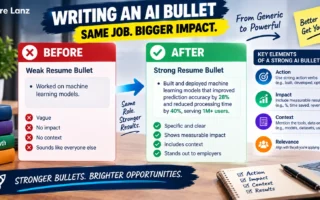
Rewrite your resume around outcomes. “Built a RAG pipeline” says almost nothing. “Cut irrelevant retrievals by 40 percent using semantic chunking and a reranker” tells a hiring manager exactly what you can do. Tie every tool to a result.
Finally, pick your lane before you apply. Decide whether you are an application builder, a retrieval specialist, an evaluation person, or an infrastructure engineer, then target roles that match. Generic applications get filtered out in a market this specialised.
Frequently Asked Questions
What does a generative AI engineer do?
They build and deploy products powered by large language models, handling model selection, retrieval pipelines, prompt design, output evaluation, and cost control. Most of the role is software engineering with a probabilistic component, not research.
Do I need a PhD for generative AI engineer jobs?
No, not for most roles. A PhD helps for research scientist positions at frontier labs, where salaries pass $400,000. For applied engineering work, shipped production experience matters far more than academic credentials.
How much do generative AI engineers earn?
Base pay typically runs $145,000 to $215,000 for mid level engineers and $230,000 or more for seniors. Glassdoor lists an average near $142,848, while Levels.fyi shows total compensation above $240,000 because it includes equity.
Is generative AI engineering a good career in 2026?
Yes, if you can prove production experience. AI Engineer has topped LinkedIn’s fastest growing job list two years running, and AI skills are the hardest to hire for worldwide. The risk is not demand, it is the shrinking number of entry level openings.
Which skills matter most for generative AI engineer jobs?
Python, LLM API work across multiple providers, RAG architecture, evaluation and observability, and deployment with Docker and a cloud platform. Vector databases and agent orchestration round out the list. Employers weight evaluation discipline heavily.
Conclusion
Generative AI engineer jobs sit at an unusual point in tech history. Pay is climbing, demand is structural rather than cyclical, and these skills barely existed as a discipline three years ago. That will not stay this open forever. The people getting hired are not the ones with the longest tool list. They are the ones who can describe a system they shipped, how it failed, and what they changed. That story is buildable in weeks, not years. Start with one project. Make it real, make it messy, and write down what broke. Then apply to the lane you have proof for. In a market with three open roles per qualified candidate, evidence beats credentials almost every time.
Related Articles: