

Published: 19 August 2026 · Last updated: 27 September 2026 · Last reviewed against official sources: 27 September 2026
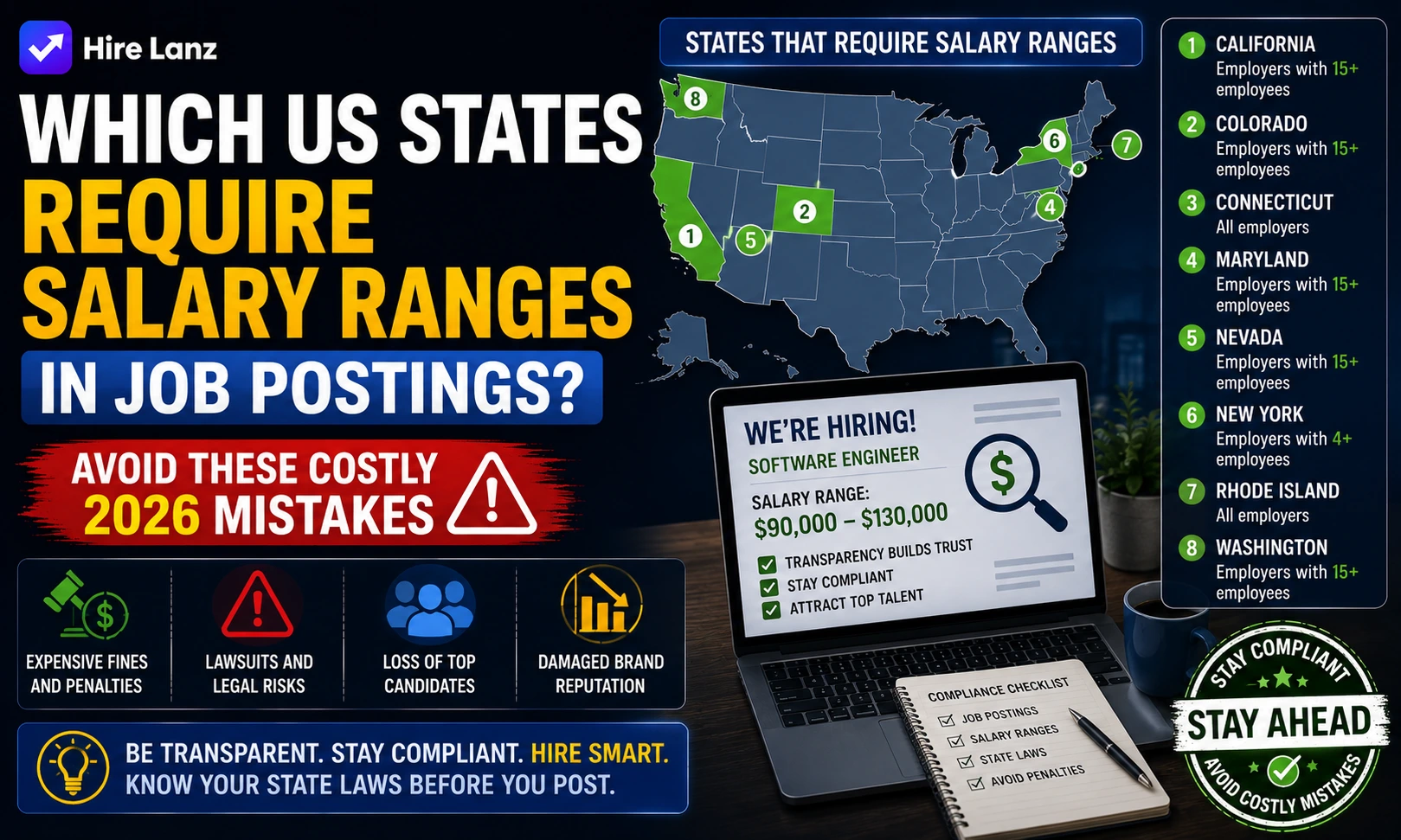
Which US states require salary ranges in job postings? As of August 2026, 13 states plus Washington, D.C. require the pay range to sit inside the job ad itself. Those states are California, Colorado, Hawaii, Illinois, Maine, Maryland, Massachusetts, Minnesota, New Jersey, New York, Vermont, Virginia and Washington. Three more states ask for the range only when a candidate requests it or before an offer lands.
The Full List of States That Require Salary Ranges in Job Postings
Colorado started the wave back in January 2021, and it still has one of the widest rules in the country. Any employer with even one Colorado worker has to include a good faith pay range. California and Washington followed in January 2023, both using a 15 employee threshold, and New York arrived that September with a much lower bar of just four employees.
The pace picked up sharply after that. Hawaii went live in January 2024 for employers with 50 or more staff, Washington, D.C. followed in June 2024, and Maryland in October 2024 with no size limit at all. Then 2025 delivered four new states in a single year: Illinois and Minnesota in January, New Jersey in June, Vermont in July and Massachusetts in late October.
This year brought two more. Virginia’s law took effect on 1 July 2026 and covers every employer with at least one Virginia worker, with no small business carve out. Maine followed on 29 July 2026 for employers with 10 or more employees. Delaware has already passed its own version, but employers there have until 26 September 2027 to get ready.
Here is the current picture for states that require salary ranges in job postings.
| State | Covered Employers | In Force Since |
|---|---|---|
| Colorado | All employers | January 2021 |
| California | 15+ employees | January 2023 |
| Washington | 15+ employees | January 2023 |
| New York | 4+ employees | September 2023 |
| Hawaii | 50+ employees | January 2024 |
| Washington, D.C. | All employers | June 2024 |
| Maryland | All employers | October 2024 |
| Illinois | 15+ employees | January 2025 |
| Minnesota | 30+ employees | January 2025 |
| New Jersey | 10+ employees | June 2025 |
| Vermont | 5+ employees | July 2025 |
| Massachusetts | 25+ employees | October 2025 |
| Virginia | All employers | July 2026 |
| Maine | 10+ employees | July 2026 |
| Delaware | More than 25 employees | September 2027 (upcoming) |
What a Compliant Pay Range Actually Looks Like
Almost every one of these laws uses the same two words: good faith. That means the range has to be what the employer honestly expects to pay the person who gets hired, judged at the moment the ad goes live. It is not a wish list and it is not a negotiating shield.
The New York Department of Labor puts it plainly: the minimum and maximum must be figures the employer believes to be accurate when the ad is posted. Regulators in several states have said that a range so wide it tells the candidate nothing can itself be a violation. A posting that reads “$60,000 to $220,000” for a mid level role is the classic example of what not to do.
California tightened this definition in 2025 through Senate Bill 642, which took effect on 1 January 2026. The state now defines a pay scale as a good faith estimate of what the employer reasonably expects to actually pay. Virginia went further and made the width of the range one of the factors used to decide whether it was set in good faith at all.
Some states also expect more than a number. Colorado and Illinois want a general description of the benefits and other compensation attached to the role. Maine took the opposite approach and left benefits out entirely, which is a good reminder that copying one state’s template into another state rarely works.
- Base the range on a real pay scale, the budgeted amount, or what current staff in the same role earn
- Keep the spread defensible, since an unusually wide band invites scrutiny
- Check whether your state also wants benefits, bonuses or commission described
- Document how each range was calculated before the ad goes live
Which States Only Require Pay Ranges on Request?
Not every pay transparency law puts the number in the advert. Connecticut and Nevada, both live since October 2021, and Rhode Island since January 2023 use a softer model. The employer must hand over the range at a set point in the process, usually on request or before an offer is made.
For job seekers, that difference matters a lot. In an on request state you can still get the number, but only if you know to ask and only after you have already invested time in the process. Asking is protected in these states, so you cannot lawfully be punished for raising the question.
Several other states have no posting rule but still ban salary history questions. Oregon is the clearest example. Employers there cannot ask what you currently earn, which stops an old low salary from anchoring your next one, even though nothing forces them to publish a range.
This is the part most compliance checklists get wrong. Pay transparency and salary history bans are two separate rules that often travel together. Virginia, for instance, brought in both at the same time in July 2026, and its salary history ban has no cure period at all.
Do Pay Transparency Laws Apply to Remote Jobs?
Yes, and this is where most multi state employers slip up. The trigger is usually where the work could be performed, not where the company is headquartered. A fully remote role advertised nationwide can be pulled into several state laws at the same time.
New York spells this out. Its rule covers any role performed at least partly in New York, and it also covers roles performed elsewhere that report to a supervisor, office or worksite inside the state. Remote positions are explicitly included.
The practical result is that a startup in Atlanta with no offices outside Georgia may still owe a compliant range, because residents of Colorado, New York, Washington and California can all apply. Most employers solve this by simply posting a range on everything rather than maintaining two versions of the same advert.
Virginia added a fresh wrinkle in 2026. Its law does not clearly say whether it reaches remote roles that could be performed in the Commonwealth, and it applies to internal postings for promotions and transfers as well as external ones. Until that is tested, cautious employers are treating internal job boards the same as public ones.
- The applicant’s location often matters more than the employer’s
- Internal promotion and transfer notices count as postings in several states
- Third party recruiters and job boards do not shift liability away from the employer
- Employee count thresholds are frequently ambiguous for multi state teams
Cities With Their Own Salary Range Rules
State law is only half the story. New York City has required ranges in postings since November 2022 for employers with four or more staff, and Jersey City and Ithaca run their own versions too. In each case, the city rule sits alongside whatever the state requires.
Ohio is the most interesting example, because the state itself has no pay transparency law while four of its cities do. Cleveland went first on the posting side, with Ordinance No. 104-2025 taking effect on 27 October 2025 for employers with 15 or more workers in the city.
Columbus followed within weeks. Its ordinance technically took effect on 3 December 2025, but enforcement against employers is delayed until 1 January 2027, which gives local businesses an unusually long runway to fix their job ads and pay bands.
Cincinnati and Toledo work differently again. Both ban salary history questions, and both require the pay range only when an applicant asks after receiving a conditional offer. So an Ohio employer hiring in Cleveland and Cincinnati on the same day is following two different rules.
What Happens If an Employer Ignores the Law?
Penalties swing wildly by jurisdiction. Cleveland’s fines run from $1,000 for a first violation up to $5,000 for a third within five years. New York City sits at the extreme end, where an uncorrected violation can reach $250,000.
Many states soften this with a cure period, which is a window to fix a bad posting before anything becomes payable. Virginia gives employers 15 business days after written notice, and New York City allows 30 days for a first violation. Fixing the ad inside that window usually ends the matter.
The bigger risk in 2026 is private litigation rather than regulator fines. Washington has already seen hundreds of class actions filed under its posting rule, and Virginia deliberately built in a private right of action alongside enforcement by the Attorney General.
There is a business cost to hiding pay as well. SHRM research found that 70% of organisations listing pay ranges received more applicants and 66% reported better candidate quality. A separate 2026 survey of 1,000 job seekers found 44% were unlikely to apply at all to a posting with no range.
- Check every live posting against the states where the role could be performed
- Build the range into the posting template rather than adding it by hand
- Set one intake address so cure notices actually reach the right person
- Brief recruiters and agencies, since their postings still count as yours
- Prepare for internal questions, because current staff read those ranges too
Summary
Fourteen jurisdictions now require salary ranges in job postings: California, Colorado, Hawaii, Illinois, Maine, Maryland, Massachusetts, Minnesota, New Jersey, New York, Vermont, Virginia, Washington and Washington, D.C. Connecticut, Nevada and Rhode Island require disclosure on request instead, and Delaware joins the posting group in September 2027. Employer size thresholds range from one employee in Colorado, Maryland and Virginia up to 50 in Hawaii. The range must be set in good faith, remote roles usually trigger the law of the applicant’s state, and several cities including New York City, Cleveland and Columbus add their own layer on top.
Frequently Asked Questions
Is there a federal law requiring salary ranges in job postings?
No. There is no federal pay transparency law. A Salary Transparency Act has been introduced in Congress but has not been enacted, so every requirement comes from state or local legislation. The Equal Pay Act still bans sex based wage discrimination nationwide.
Which state has the strictest pay transparency law?
Colorado, Maryland, Washington, D.C. and Virginia are the broadest, because they apply to employers with just one worker in the jurisdiction. Virginia is arguably the toughest overall, since it also covers internal postings and lets individuals sue directly.
Do these laws cover promotions and internal transfers?
In several states, yes. Virginia, Illinois and New York all extend disclosure duties to internal opportunities such as promotions and transfers. Illinois also requires employers to notify current staff about promotion openings within 14 days of posting them externally.
Can an employer post a very wide range to stay flexible?
Not safely. Most laws require a good faith range, and regulators treat an artificially broad band as a violation in itself. Virginia explicitly makes the width of the range a factor when deciding whether it was set honestly.
What should I do if a job ad in my state has no salary range?
You can ask the employer directly, and in covered states you cannot be penalised for asking. If the posting still lacks a range, you can report it to your state labour department, which is often what starts the cure clock.
Conclusion
The question of which US states require salary ranges in job postings has a different answer every year, and 2026 was a busy one. Two new states arrived in July alone, one more is scheduled for 2027, and no state that has adopted these rules has ever repealed them. The safest planning assumption is that your market is next. For employers, the fix is unglamorous but effective. Build defensible pay bands, put the range into the posting template so nobody has to remember it, and treat remote roles as if the strictest applicable state law applies.
Related Articles:
How Does H-1B Wage Level Affect Your Lottery Odds? The Costly 2026 Shift
How Much Does It Cost an Employer to Sponsor a Visa? The Complete Cost Breakdown 2026