
Published: 19 August 2026 · Last updated: 27 September 2026 · Last reviewed against official sources: 27 September 2026
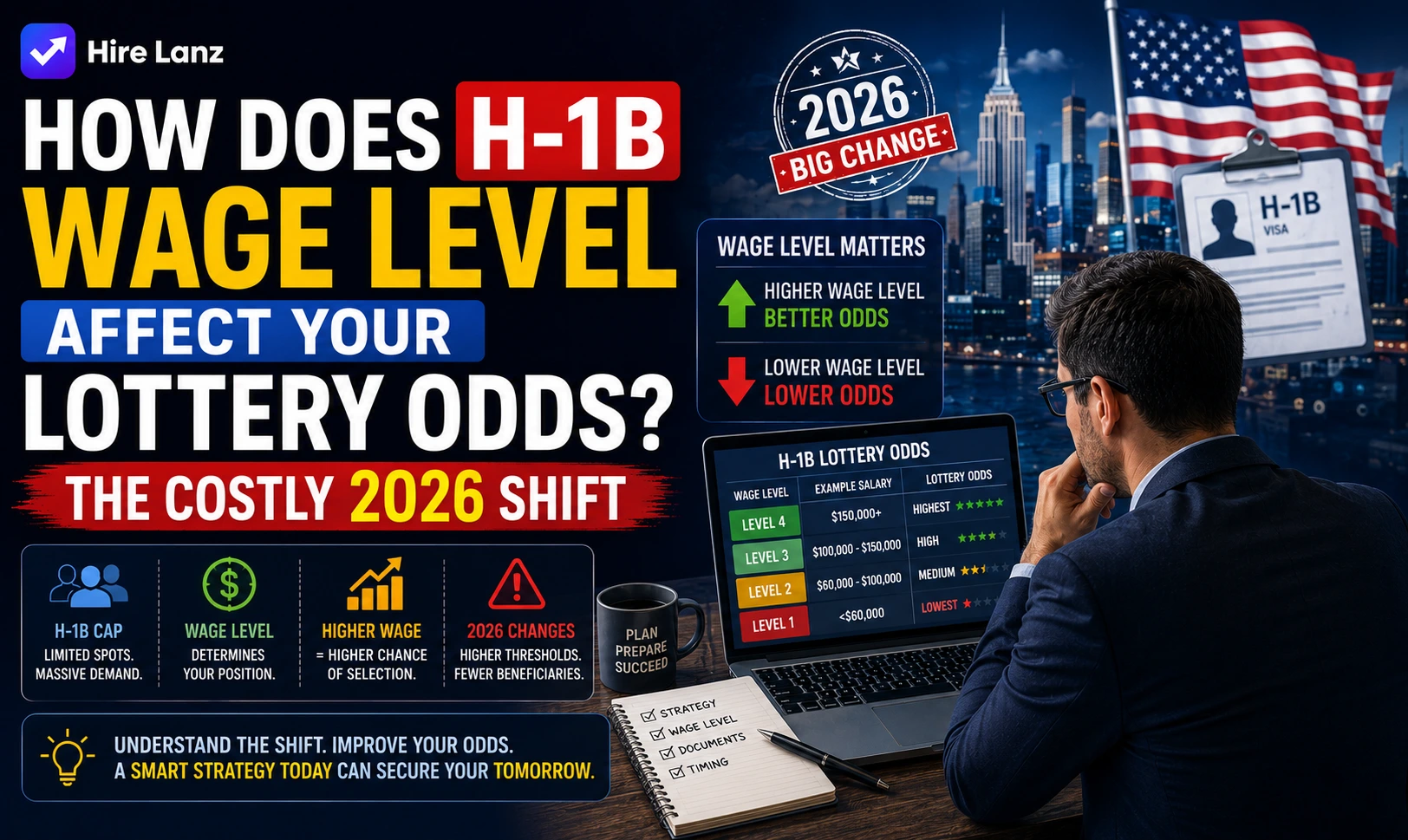
How does H-1B wage level affect your lottery odds? Your H-1B wage level now decides how many times your name goes into the selection pool. Level I gets one entry, Level II two, Level III three, and Level IV four. Since February 27, 2026, USCIS no longer treats every registration equally, so a higher wage level means better odds of being picked. That one change rewrote the H-1B playbook. The first season under the new system, FY 2027, is finished and the real numbers are in. Here is how the weighting works, what the results looked like, why a big paycheck does not always mean a high wage level, and what actually moves your odds before the next window opens.
The H-1B Lottery Is Not a Coin Flip Anymore
For years the cap lottery was pure luck. Congress limits new H-1B visas to 65,000 a year, plus 20,000 for holders of a U.S. master’s degree. Registrations always outnumbered visas, so USCIS ran a computer draw. A $70,000 offer and a $200,000 offer had identical odds.
That ended in December 2025. DHS published its final rule on weighted selection in the Federal Register on December 29, 2025, and it took effect February 27, 2026, in time for the FY 2027 cap season. The agency finalized it without changing a word from the September 2025 proposal.
The registration form changed with it. Employers once submitted little more than names and passport details. Now every registration must carry the Standard Occupational Classification (SOC) code, the area of intended employment, and the OEWS wage level the offered salary meets. Wage data is reviewed before selection instead of after.
Many attorneys expected a lawsuit to stop it. None arrived in time. Forbes reported in March 2026 that no company or business group had sued, even though plenty of lawyers believed the rule overstepped the agency’s authority. The lottery ran under it.
How Your H-1B Wage Level Turns Into Lottery Entries
The mechanic is simple. USCIS identifies the highest OEWS wage level your offered salary meets or exceeds for that SOC code in that area of employment, then drops that many entries into the pool.
| Wage Level | What It Usually Reflects | Lottery Entries | DHS Projected Odds |
|---|---|---|---|
| Level I | Entry Level | 1 | About 15.3% |
| Level II | Qualified | 2 | About 30.6% |
| Level III | Experienced | 3 | About 45.9% |
| Level IV | Fully Competent | 4 | About 61% |
Those projections are DHS’s own, published in the rulemaking. Under the old system the average selection rate hovered near 29.6% for everyone. A Level IV candidate roughly doubles that. A Level I candidate loses about half of it.
One point trips people up constantly. Extra entries change your probability, not your allocation. Each beneficiary still counts once against the 85,000 cap. Four entries do not mean four visas, and they do not mean a guarantee. Level IV registrations still lose, and Level I registrations still win.
The master’s cap works the same way. USCIS runs the regular draw first, then a second round for U.S. advanced degree holders who were not picked. Both rounds are weighted, so a master’s graduate at Level I carries one entry into each.
Quick rules worth memorizing:
- Weighting follows your OEWS wage level, not your salary in raw dollars.
- If several employers register the same person, the lowest wage level among them controls.
- If a job covers multiple worksites, the lowest applicable wage level controls.
- If the offer is a salary range, USCIS uses the bottom of that range.
What the FY 2027 Numbers Actually Showed
Registration ran from March 4 to March 19, 2026. Selection notices began on March 27, and USCIS confirmed on March 31 that both caps were met. Petitions were filed between April 1 and June 30, with employment starting no earlier than October 1, 2026.
Demand collapsed. Properly submitted registrations fell from 343,981 for FY 2026 to 211,600 for FY 2027, a drop of 38.5%. Two forces pushed the same way. The math turned against employers who file entry-level cases in bulk, and a separate $100,000 fee on certain new petitions made offshore hiring hard to budget for.
The winners looked different too. Roughly 71.5% of selected beneficiaries held a U.S. master’s degree or higher, up from about 57% the year before. Only 17.7% of selected registrations sat at Level I. Entry-level candidates were not shut out, but their share of the winners shrank sharply.
Then came the twist. With so many registrations gone from the pool, actual selection rates beat the DHS forecast at every level. One immigration firm reported its Level I clients hit about 24.5% against a projected 15.3%. That is a single firm’s client base, not a national figure, and USCIS has not itemized selection counts by wage level. Your odds depend on your level and on how many people show up.
Why a High Salary Does Not Always Mean a High H-1B Wage Level
This is where good candidates lose. Your wage level does not measure how much money you make. It measures where your salary sits inside the local pay distribution for your occupation, using Department of Labor OEWS data. Level I sits near the 17th percentile, Level II the 34th, Level III the 50th, and Level IV the 67th.
Picture two software developers, both offered $130,000. In a lower-cost metro that salary might clear Level III and earn three entries. In the San Francisco Bay Area, where developer pay runs far higher, the same $130,000 might only reach Level I and earn one. Same title, same money, very different odds.
DHS acknowledged this during rulemaking, and employer groups warned about it in comments. Many H-1B workers earn well above the U.S. average yet still land at Level I or II because their occupation and metro are expensive. Critics called it a pay-to-play system. DHS finalized it anyway.
You do not have to guess where you land. The DOL’s OFLC Wage Search tool returns all four wage thresholds for any SOC code and geographic area, free of charge. Ten minutes with it before an offer is negotiated is worth more than any amount of speculation afterward.
Four things that decide your level:
- Your SOC occupation code, which must genuinely match the job duties.
- The geographic area of intended employment, including remote work locations.
- The offered wage, measured against the four OEWS thresholds for that code and area.
- The lowest applicable value when there is more than one worksite, employer, or salary figure.
The Quiet Traps That Pull Your Wage Level Down
The lowest-value rules exist to stop gaming, and they catch honest cases too. If a role lists three worksites and the wage clears Level III in two but only Level I in the third, the registration is weighted at Level I. Listing every possible office out of caution hands you the weakest entry in the pool.
Salary ranges create the same problem. If the offer letter says $110,000 to $145,000, USCIS uses the bottom number. A range that looks generous to a candidate can quietly cost two or three lottery entries. Committing to a single figure before registration is often the cheapest odds improvement available.
Multiple registrations get flattened as well. If one employer registers a candidate at Level III and another registers the same person at Level I, the weighting drops to Level I. A well-meaning backup sponsor can undercut the primary one without either side noticing.
The integrity side has teeth. The wage level, SOC code, and work location on your petition must match the registration, and petitioners must supply evidence supporting the level as of the registration date. USCIS may deny or revoke petitions where an employer chose an inappropriate level to improve odds. Inflating a level is not a strategy.
How to Improve Your Odds Before the Next Registration
FY 2028 registration is expected in early 2027, so the work starts now rather than in February. Every decision that matters happens months before the portal opens: the job description, the SOC code, the salary, and the worksite.
Level your roles honestly, then document the reasoning. If a position genuinely requires several years of experience, independent judgment, or supervision of others, the higher level is defensible and worth claiming. Save the OEWS printouts and the org chart. That file becomes your evidence package.
Budget realism matters too, and a bigger change may be coming. On March 27, 2026, the Department of Labor proposed raising all four thresholds from roughly the 17th, 34th, 50th and 67th percentiles to the 34th, 52nd, 70th and 88th. Comments closed May 26, 2026 and the rule is not final. If it lands, today’s Level II salary could become tomorrow’s Level I.
Finally, build a plan B before you need one. Cap-exempt employers such as universities and qualifying nonprofit research organizations sit outside the lottery and can sponsor year round. Other categories may fit depending on the role. Because outcomes turn on individual facts, bring in a licensed immigration attorney.
Five things to do before the next cap season:
- Audit every H-1B-eligible role for an accurate SOC code and a defensible wage level.
- Run each planned offer through the OFLC Wage Search tool for the exact metro area.
- Replace salary ranges with a single committed figure before registering.
- List only the worksites the role genuinely requires, and check the level in each one.
- Coordinate with candidates so a second employer’s low registration does not drag the weighting down.
Summary
The H-1B lottery is now weighted by wage level. Level I earns one entry, Level II two, Level III three, and Level IV four, based on the highest OEWS threshold your salary meets for your SOC code and work location. DHS projected odds from about 15% at Level I to about 61% at Level IV. In FY 2027 registrations fell 38.5% to 211,600, advanced degree holders rose to 71.5% of selections, and Level I shrank to 17.7% of those chosen. Because the pool got smaller, real selection rates beat the forecast at every level. Wage level depends on local pay data rather than raw salary, and the lowest applicable level always controls.
Frequently Asked Questions
Is the H-1B lottery still random?
Yes, selection is still random, but the pool is no longer flat. Each registration receives one to four entries depending on its OEWS wage level. Randomness decides who gets pulled. Wage level decides how many chances you have.
Does a Level IV wage guarantee selection?
No. Four entries improve your probability substantially, but nothing is guaranteed. DHS projected roughly 61% odds at Level IV, which still leaves a real chance of being passed over. Each beneficiary counts once against the cap regardless of entries.
Do master’s degree holders still get an advantage?
Yes, they still get two shots. USCIS runs the regular cap selection first, then a second round for U.S. advanced degree holders who were not picked. Both rounds are weighted by wage level, so a low wage level limits you in each draw.
How do I check my H-1B wage level?
Use the Department of Labor’s OFLC Wage Search tool. Enter the SOC code for the position and the area of intended employment, and it returns the four wage thresholds. Compare your offered salary against them to find the highest level you meet.
What happens if my employer picks the wrong wage level?
USCIS may deny or revoke the petition. The wage level, SOC code, and work location on your petition must match the registration, and the employer must provide evidence supporting the level. Choosing an inflated level to gain entries carries real consequences.
Are cap-exempt employers affected by this rule?
No. Universities, related nonprofit entities, and qualifying nonprofit or government research organizations remain outside the annual cap. They can sponsor H-1B workers year round without entering the weighted lottery at all.
Conclusion
Your H-1B wage level is now the most controllable factor in your lottery odds. The cap size, the number of competitors, the timing of the draw, none of that is in your hands. The wage level is, and the gap between one entry and four is the difference between long odds and favorable ones. Treat cap season as a year-round exercise. Confirm the right SOC code, check the OEWS thresholds for your metro area, commit to a single salary figure, list only the worksites you need, and keep the paperwork behind your leveling decision. Watch the pending DOL wage proposal too, because the thresholds themselves may rise.
Related Articles:
How Much Does It Cost an Employer to Sponsor a Visa? The Complete Cost Breakdown 2026