
Published: 15 August 2026 · Last updated: 27 September 2026 · Last reviewed against official sources: 27 September 2026
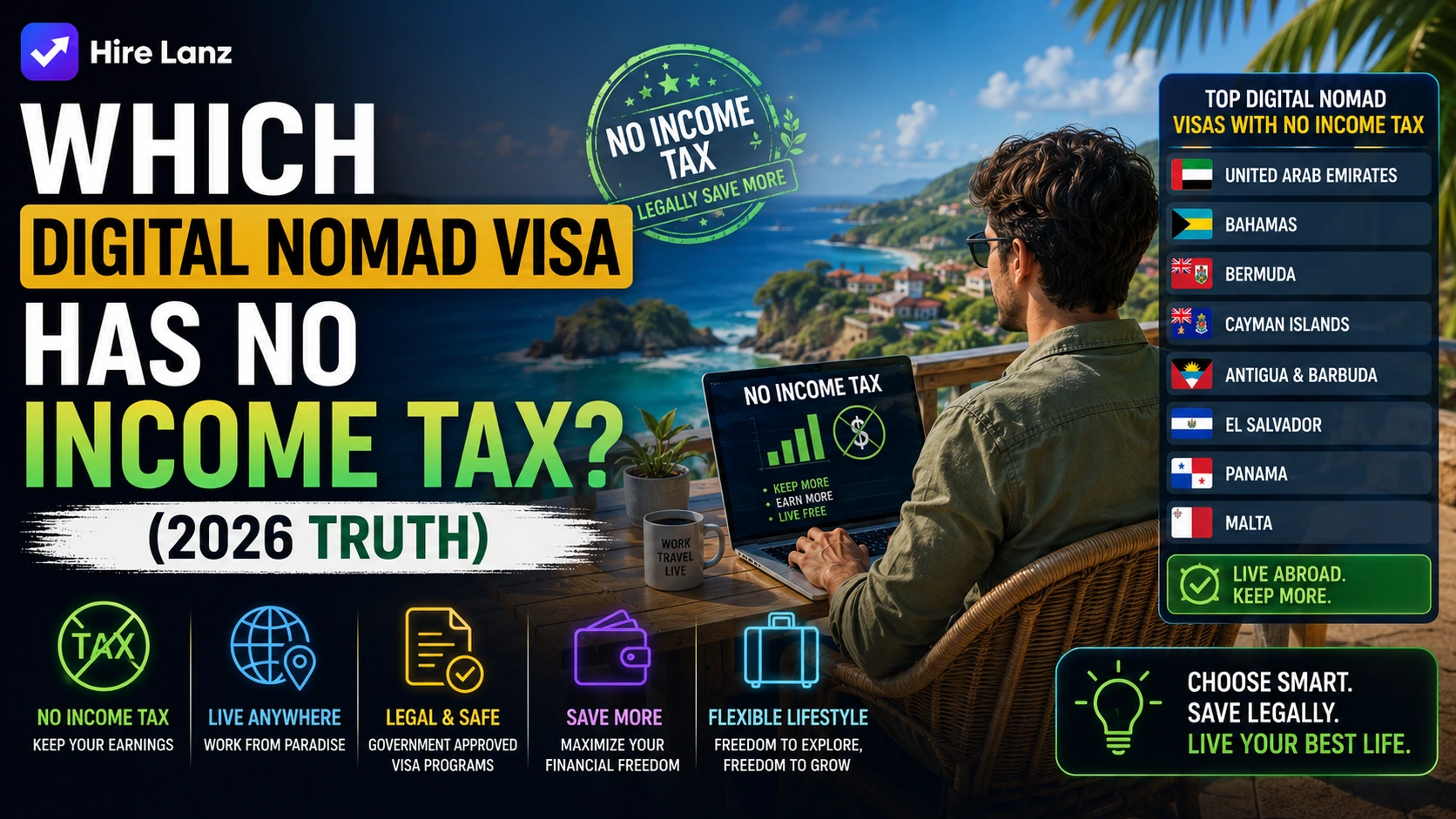
Which digital nomad visa has no income tax? In 2026 the honest answer is the UAE Virtual Working Programme, because the United Arab Emirates charges zero personal income tax on anyone, and Dubai’s remote work permit lets you live there legally on $3,500 a month. Close behind sit Croatia, Costa Rica and Panama, which exempt your foreign earnings by law.
What “No Income Tax” Really Means on a Nomad Visa
Three mechanisms get sold under the same tax free banner, and confusing them is the most expensive mistake remote workers make.
The first is a true zero tax jurisdiction. There is no personal income tax code at all, so nobody pays, residents and foreigners alike. The UAE, Cayman and the Bahamas work this way, meaning there is no exemption to lose.
The second is a statutory carve out. The country taxes its own people normally but writes an exemption for permit holders into law. Croatia is the cleanest example anywhere. Its Income Tax Act states plainly that income from an employer not registered in Croatia, received on the basis of digital nomad status, is not taxed.
The third is territorial taxation, where only income originating inside the borders is taxed, so your salary from a client in London falls outside the net. Panama has run this for decades. The difference matters the moment you take a local client, because a carve out can stop protecting you.
Which Digital Nomad Visa Has No Income Tax in 2026?
These programmes deliver a genuine 0% local bill this year.
| Programme | Income Needed | Length | Local Tax on Foreign Income |
|---|---|---|---|
| UAE Virtual Working Programme | $3,500 / month | 1 year, renewable | 0% (no personal income tax) |
| Croatia Digital Nomad Permit | €3,622.50 / month | Up to 18 months | 0% (written exemption) |
| Costa Rica Remote Worker Visa | $3,000 / month | 1 year + 1 renewal | 0% (territorial system plus exemption) |
| Panama Short Stay Remote Worker | $36,000 / year | 9 months + 9 months | 0% (territorial system) |
| Barbados Welcome Stamp | $50,000 / year | 12 months | 0% (statutory non-resident treatment) |
The UAE is strongest for higher earners. No personal income tax, no capital gains tax on individuals, and non GCC expats pay no social security. Since 27 January 2026 you must show six months of bank statements, not three, so older guides are wrong.
Croatia is the standout for a European base. It is the rare EU country where the exemption survives the 183 day residency threshold, so you can stay the full permit and still owe nothing on your foreign salary.
Costa Rica and Panama are the value picks. Both sit near $3,000 a month and both bar you from taking local clients. That restriction is not a footnote. It is the condition your exemption rests on.
- Highest earners: UAE, or Cayman if confirmed open
- European base: Croatia
- Best value: Costa Rica and Panama
- Caribbean lifestyle: Barbados Welcome Stamp
UAE Virtual Working Programme: The Zero Tax Heavyweight
The UAE permit is a one year, self sponsored residence visa for people employed by a company registered outside the Emirates. Official guidance requires proof of remote work plus a salary certificate showing $3,500 a month.
Business owners face a higher bar near $5,000 a month plus proof of company ownership for a year.
Now an important correction. In late 2025 an article claimed the UAE would introduce a 5% personal income tax from January 2026, and it spread fast. It is not true. No legislation introduced personal income tax, and the rate stands at 0% for 2026. The 5% people half remember is VAT, applied since 2018. A separate 9% corporate tax hits profits above AED 375,000, which can catch freelancers with a UAE entity.
The catch is cost, not tax. Dubai rents are high, the visa is invalidated if you leave the UAE for more than six consecutive months, and it does not lead to permanent residency.
Croatia: The EU Permit With a Written Tax Exemption
Croatia’s exemption is not an administrative practice or a grey area nobody has noticed. It is written into the Income Tax Act, and it is why this permit beats every other European option on tax.
The 2026 threshold is €3,622.50 a month, set at 2.5 times the previous year’s average Croatian net salary. It resets every spring, so guides quoting €2,870 or €3,295 are behind. The permit runs up to 18 months.
The exemption is narrow by design, and this part is worth reading twice. It covers **earned income from foreign remote work only**. Dividends, interest, capital gains, rent and pensions fall under ordinary rules once residency arises, generally at 12%. If much of your income is passive, Croatia solves less.
There is a structural limit too. You must leave for six months before reapplying, and the permit does not build toward permanent residence. It is an 18 month tax free chapter, not a place to settle.
- Applies even past 183 days of physical presence
- Covers foreign employment and freelance income, not investments
- Non EU citizens only, as EU nationals have free movement
- You cannot invoice Croatian clients
Costa Rica and Panama: Territorial Tax Done Properly
Costa Rica introduced its remote worker visa under Law 10008 in 2021. Holders are explicitly exempt from Costa Rican income tax on foreign earnings, even past 183 days. You need $3,000 a month solo or $4,000 with dependants.
The extras are useful. You can open a local bank account, your foreign driving licence stays valid, and you can import work equipment duty free. Electronics duties can add a quarter to the price, so that saving is real.
Panama’s Short Stay Remote Worker Visa, created by Executive Decree 198, needs $36,000 a year from foreign sources. It runs nine months and extends once. Its territorial system is among the purest anywhere, codified in the Fiscal Code.
Both share a limitation. Neither leads to permanent residency, and Costa Rica caps you at two years before you must switch to Rentista, Pensionado or an investor category. Plan the exit before the arrival.
The Traps: Visas That Look Tax Free But Are Not
Malta was the biggest casualty. Its Nomad Residence Permit was widely sold as a 0% option, and for the first 12 months it still is. After that, guidelines published on 16 January 2026 confirm a flat 10% on authorised work income.
Thailand’s DTV is misunderstood constantly. It grants no tax exemption at all. Stay 180 days or more in a calendar year and you become a Thai tax resident, and since 2024 foreign income remitted into Thailand is assessable whenever it was earned.
Indonesia’s E33G catches people badly. Holding a KITAS demonstrates intent to reside, which can make you a tax resident from arrival however few days you stay. A four year relief exists, but it is not automatic.
Then the biggest trap, which has nothing to do with your host country. Your home country still wants its share. Americans file on worldwide income wherever they live, though the Foreign Earned Income Exclusion shelters roughly $130,000 in 2026. Everyone else must formally break tax residency at home.
- Malta: 0% for 12 months, then 10% flat
- Thailand DTV: no exemption, 180 day trigger, remittances taxable
- Indonesia E33G: the KITAS can trigger residency from day one
- Spain: the Beckham regime gives 24%, not 0%
- Cayman: genuinely zero tax, but sources disagree on whether its Global Citizen
- Concierge Program still accepts applications
Summary
Four programmes deliver a genuine 0% local bill in 2026 through three legal routes. The UAE wins because no personal income tax exists there. Croatia wins on legal certainty in Europe. Costa Rica and Panama win on affordability. Two corrections matter more than any recommendation. The UAE has not introduced a 5% personal income tax, despite the rumour, and Malta now charges 10% after year one. A host country exemption is only half your tax position, and no visa here touches the other half.
Frequently Asked Questions
Which digital nomad visa has no income tax at all?
The UAE Virtual Working Programme is the clearest case, because the UAE has no personal income tax system at all. Cayman and the Bahamas are also genuine zero tax jurisdictions. Croatia, Costa Rica and Panama reach 0% through exemptions instead.
Does a tax free nomad visa mean I pay no tax anywhere?
No, and this assumption costs people thousands. These visas only remove your liability in the host country. US citizens file on worldwide income wherever they live, and others must formally exit their home tax system.
Did the UAE really introduce a 5% income tax in 2026?
No. The claim spread from a late 2025 article, but no legislation was passed. The UAE personal income tax rate is 0% for 2026. The 5% figure refers to VAT, in place since 2018.
Is Croatia’s exemption safe if I stay over 183 days?
Yes, and this is Croatia’s key advantage. The exemption sits in the Income Tax Act specifically for permit holders, so the 183 day trigger does not pull your foreign salary into Croatian tax.
What is the cheapest nomad visa with no income tax?
Costa Rica and Panama sit lowest among the genuine 0% options, at $3,000 a month and $36,000 a year. Mauritius asks nearer $1,500 a month, though its treatment depends on residency and remittance.
Do I still pay social security on these visas?
Usually not in the host country, but check your home system. Non GCC expats in the UAE pay nothing. Croatia’s exemption does not automatically cover social contributions, and some countries keep charging after you leave.
Conclusion
Which digital nomad visa has no income tax comes down to matching the legal mechanism to your situation rather than chasing a headline rate. The UAE offers the most durable zero because there is no tax to lose, Croatia offers Europe’s strongest written guarantee, and Costa Rica and Panama offer the same outcome far more cheaply. Before applying, do three things. Confirm current figures with the immigration authority, because thresholds like Croatia’s move every year. Work out how you will exit tax residency at home, since that is where most of your liability sits. And check that your income is genuinely active foreign earnings, because most exemptions exclude dividends, rent and capital gains.
Related Articles:
Does the US Have a Digital Nomad Visa? Risky Myth, Real Fix (2026)
Work Visa for IT Professionals in Europe 2026: Fast Routes, Costly Mistakes