
Published: 24 August 2026 · Last updated: 27 September 2026 · Last reviewed against official sources: 27 September 2026
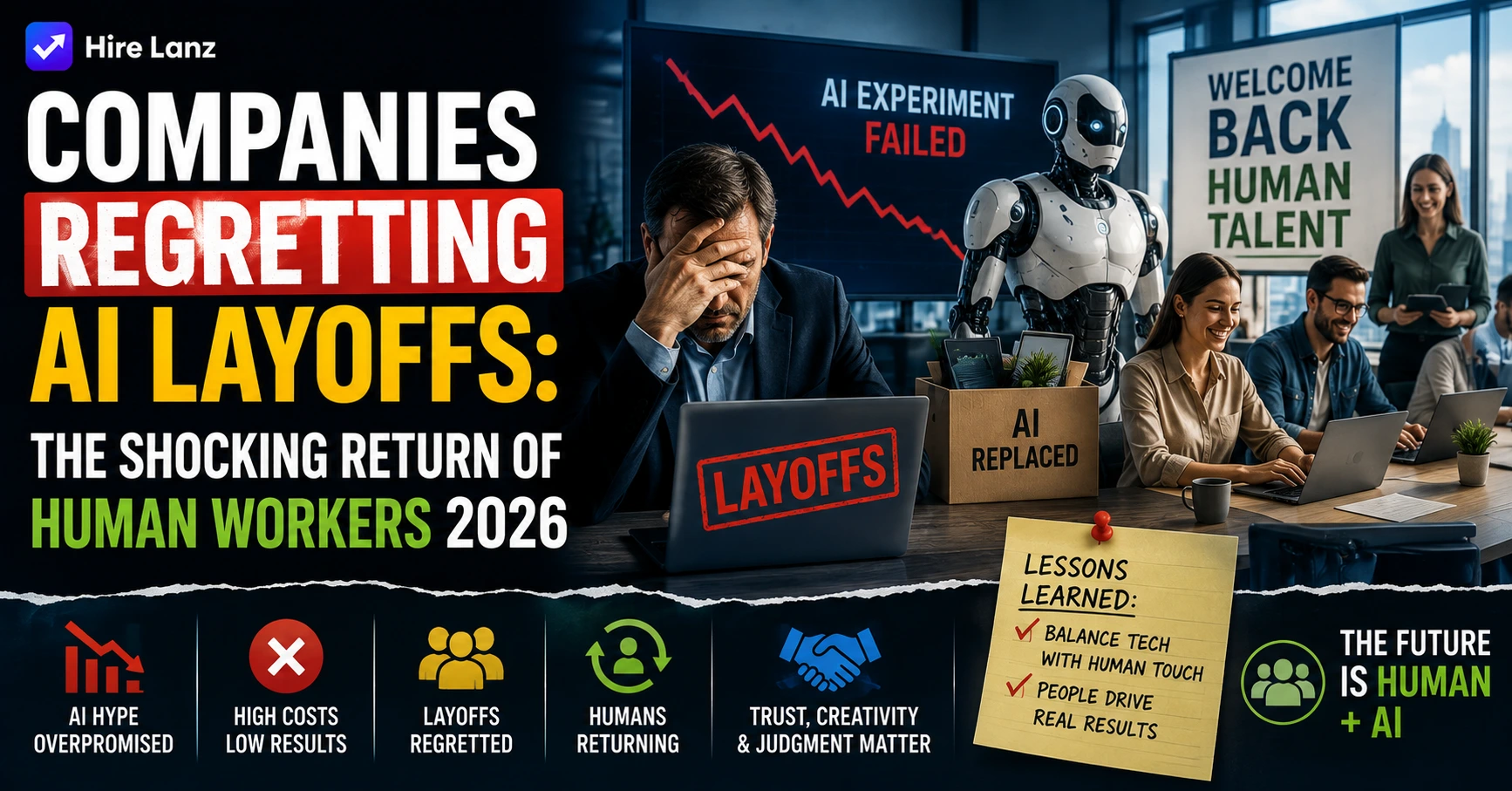
Companies regretting AI layoffs and rehiring workers has become one of the defining workplace stories of 2026. Forrester found 55 percent of employers now regret the job cuts they made in the name of artificial intelligence. Gartner expects half of all firms that cut roles for AI to rehire for similar work by 2027. The chatbot did not fail outright. It just could not finish the job.
What Is Driving Companies Regretting AI Layoffs and Rehiring Workers?
The list of companies regretting AI layoffs and rehiring workers keeps growing, and the pattern repeats. A firm announces an AI rollout. Headcount drops. Six to twelve months later the same job quietly reappears on the careers page, often under a new title.
What breaks is rarely the technology. The AI handles most of the work, then stalls on the messy remainder that needs judgment or an apology. Reporting through 2026 shows employers are already reversing those decisions, usually without saying much in public.
Careerminds polled 600 HR professionals in February 2026 and found two in three employers who made AI driven cuts had started rehiring, most within six months.
Visier tracked rehiring across 2.4 million employees at 142 companies and logged the highest rate of staff returning to old employers since 2018. Robert Half found around a third of US hiring managers who cut a role for AI later rehired for it.
Companies Regretting AI Layoffs and Rehiring Workers: The Real Cases
Klarna is the case everyone cites. In February 2024 the Swedish fintech said its OpenAI powered assistant did the work of about 700 agents. By May 2025, CEO Sebastian Siemiatkowski admitted the company had leaned too hard on cost, quality had slipped, and Klarna was recruiting human agents again. Klarna disputes the word reversal, noting it never removed human support entirely.
Ford hit the same wall on the factory floor. After building an AI vision system backed by hundreds of cameras, it found the software missed defects veteran engineers caught by eye. Ford brought back roughly 300 engineers. Vice president Charles Poon said the technology is only as good as the data behind it.
The Commonwealth Bank of Australia had the shortest turnaround. It cut about 45 customer service roles after deploying an AI voice bot, then reversed within weeks and apologised to staff. The Finance Sector Union said call volumes were actually climbing.
IBM is the honest counterexample. AI agents absorbed the work of a few hundred HR staff, yet headcount rose because the savings funded programmers and sales. That is redeployment, not regret, and it is the outcome the rehiring firms wanted but never planned for.
Quick takeaways from these cases:
- Failures cluster in customer facing and quality work, not back office processing.
- Reversals came fast, usually inside a year of the announcement.
- Leaders admitted an obsession with cost, not a broken model.
- Firms that planned redeployment first, like IBM, never needed a reversal.
| Company | What Was Cut | What Happened Next |
|---|---|---|
| Klarna | Support roles equal to about 700 agents | Rehired humans for complex and premium cases |
| Ford | Human quality checks replaced by AI cameras | Brought back roughly 300 engineers |
| Commonwealth Bank | About 45 call centre roles | Reversed the cuts and apologised to staff |
| IBM | Several hundred HR roles | No reversal; budget moved to engineering |
Why AI Could Not Replace These Workers
The first gap is judgment. AI can retrieve a refund policy in a second. It cannot decide that this customer, on this day, deserves an exception the policy does not cover. That call comes from experience, and experience does not sit in a knowledge base.
The second gap is confidence without accuracy. Klarna’s assistant sometimes gave fluent answers about fees that were wrong. In finance a wrong answer about money is a compliance problem, and unwinding it costs more than the salary saved.
The third gap is institutional memory. Long serving staff carry unwritten context about clients and exceptions. Ford is the clearest case, because the engineers who spotted defects built that instinct over many product cycles. When they left, the knowledge went with them.
The fourth gap is oversight, and this is where most companies regretting AI layoffs and rehiring workers got caught. They cut the very people who would have supervised the AI they installed. Quality drifts, and nobody notices until customers complain.
The Hidden Cost of Getting AI Layoffs Wrong
The financial case weakens every time somebody audits it. Forbes reporting on how AI layoffs are backfiring describes firms that traded quality for speed. In the Careerminds data, nearly 31 percent said rehiring cost more than the layoffs saved.
Orgvue put a number on it. Once severance, lost productivity and replacement costs are counted, companies spend about 1.27 dollars for every dollar saved through workforce reductions. That is before counting the customers who left quietly.
Then there is the trust cost, which never appears on a balance sheet. Staff who survived watched colleagues get replaced by software. When the same job is reposted months later, they read it as poor planning and start looking elsewhere.
Returning workers also have leverage and they know it. Rehired staff are negotiating higher salaries, because the employer needs that knowledge back fast. A cost cutting move ends up inflating payroll.
What the reversal actually costs:
- Severance paid, then recruitment paid again for the same seat
- Months of weak output while a replacement learns the role.
- Customer churn and complaints during the gap.
- Higher pay demands from returning workers.
What the Rehiring Trend Means for Workers in 2026
The honest reading is cautiously good news, with an asterisk. Roles are coming back, but reshaped. The job that returns pairs a person with AI rather than restoring the old workflow, and the title often changes to save face.
The asterisk is location and level, because companies regretting AI layoffs and rehiring workers do not always rehire locally. Forrester warns the roles may not go back to the same people or the same country. Entry level jobs carry the most risk, because AI absorbs the simple tasks first.
That squeeze shows in wider data. A New York Fed survey found AI driven hiring cuts were concentrated in jobs requiring a college degree, which matches reports of graduates struggling to land a first role.
If you are job hunting, target the employers who cut fastest and hurt most. Watch for eliminated roles quietly reopening, and apply as the human plus AI hybrid the company now knows it needs.
How Leaders Can Avoid the Same Expensive Mistake
Start by mapping where judgment actually sits. An org chart will not show you. A week with the team will, because the valuable part of most roles is exception handling, not the routine volume everyone measures.
Measure quality before you scale. Klarna judged its rollout on handle time and average satisfaction, which looked excellent. The hard cases were failing inside those averages the whole time. Break metrics down by difficulty and the truth shows early.
Automate tasks rather than people. Most jobs are a bundle, and AI is strong at some parts and weak at others. Removing a person to automate 60 percent of their work is how firms end up reposting that job next spring.
Keep humans in the loop on purpose. Set an escalation path, a threshold where a person takes over, and enough staff to review the system. Retraining is cheaper than rehiring, and it is now the more common response.
A practical checklist before any AI driven restructure:
- Map which decisions in the role need human judgment.
- Set a quality baseline by case complexity, not averages.
- Run a real pilot with the affected team involved.
- Define where a human always takes over.
- Budget for retraining before severance.
Summary
Companies regretting AI layoffs and rehiring workers is no longer a rumour, it is a measured trend. Forrester puts employer regret at 55 percent, and Gartner expects half of AI attributed cuts to be undone by 2027. Klarna, Ford and Commonwealth Bank all changed course in public. The reason is the same every time. AI handled the volume but not the judgment, and cutting the people who would have supervised it widened the gap. Rehiring often costs more than the layoffs saved. What works is AI alongside people, with the handover designed on purpose.
Frequently Asked Questions
Why are companies regretting AI layoffs and rehiring workers?
AI handled routine volume well but failed on complex or high stakes cases. Quality dropped and complaints rose. Many firms also cut the staff needed to supervise the AI they installed.
Which companies have publicly reversed AI job cuts?
Klarna, Ford and the Commonwealth Bank of Australia. Klarna rehired support agents after quality slipped. Ford brought back around 300 engineers when AI cameras missed defects. Commonwealth Bank reversed about 45 cuts.
Do employers actually regret AI layoffs?
Forrester found 55 percent of employers regret the cuts they attributed to AI, and Orgvue reported similar figures among UK leaders. The regret is about how fast and how deep the cuts went, not about using AI at all.
Does rehiring cost more than the layoffs saved?
Often, yes. Around 31 percent of organisations in the Careerminds survey said restaffing cost more than they saved. Orgvue estimates firms spend roughly 1.27 dollars for every dollar saved once severance is counted.
Will my old job come back if AI replaced it?
Possibly, but it will look different. Roles return reshaped around AI, sometimes under a new title or at lower pay. Mid career and customer facing roles come back fastest. Entry level positions face the most pressure.
Conclusion
The first wave of AI adoption ran on a simple assumption, that fewer people means lower costs. Reality has been more expensive. Companies regretting AI layoffs and rehiring workers are not proving that AI failed. They are proving that replacing a person is different from automating a task, and the difference shows up in complaints, compliance risk and a payroll bill that grew instead of shrinking. If you lead a team, map the judgment before you cut headcount. If AI has touched your role, document the problems you solve that it cannot.
Related Articles:
Can I Work Remotely on a Tourist Visa? Risks and Safe Rules (2026)
Can I Work for a US Company From Home Without a Visa? (2026) Legal or Risky?