
Published: 22 August 2026 · Last updated: 27 September 2026 · Last reviewed against official sources: 27 September 2026
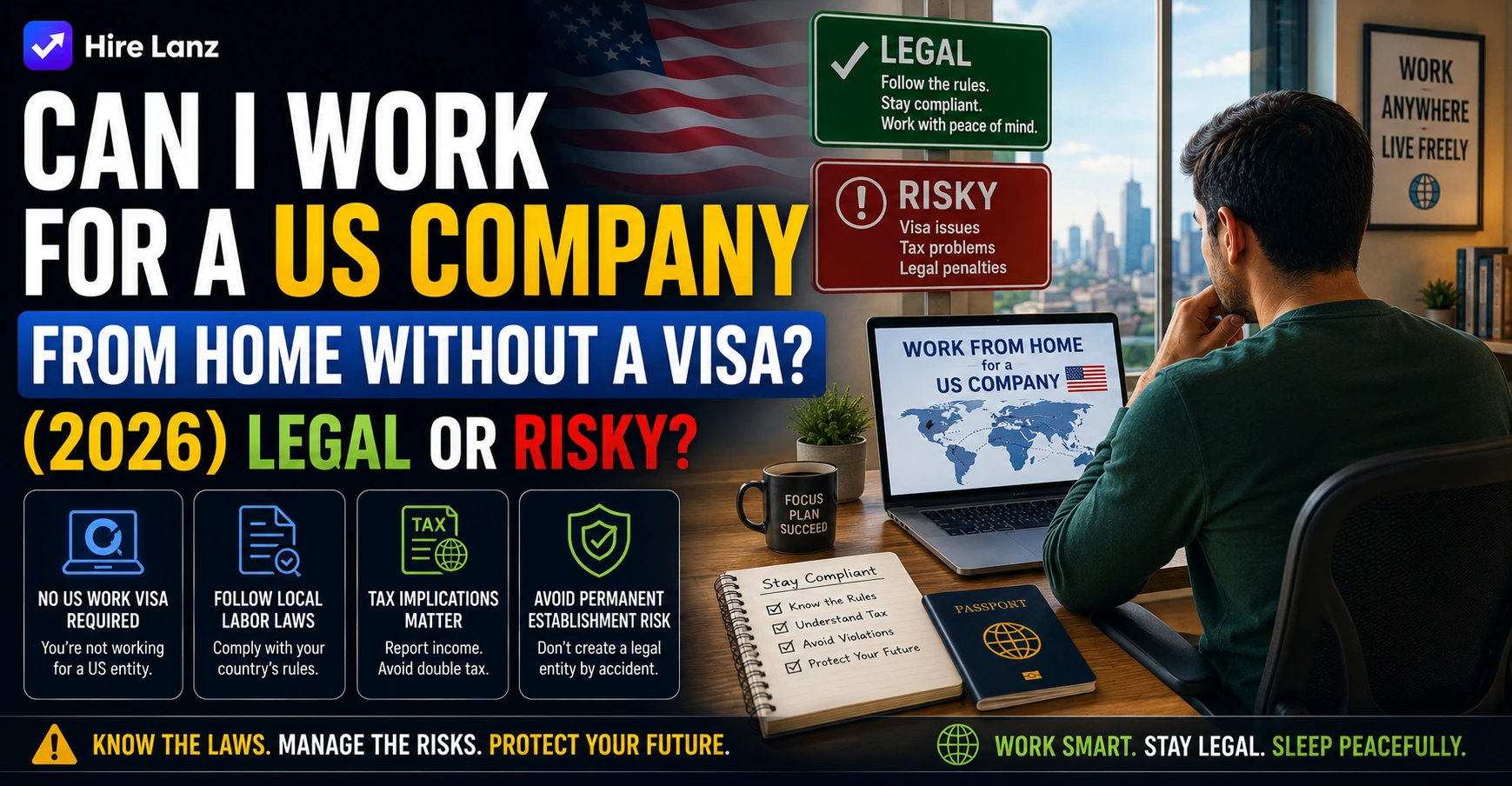
Can I work for a US company from home without a visa? Yes, in almost every case, as long as your home is outside the United States. A US work visa controls who may work on American soil, not who an American business may pay in other countries. That distinction is what most people get wrong. Immigration law follows your feet, not your paycheck. What matters is where your laptop sits. What remains are your host country’s rules, your tax residency, your contract type, and one mistake that has cost people years of US entry.
Why no US visa is needed when you work from your own country
US immigration law is territorial. It governs activity inside US borders. When a company in Austin pays a developer in Karachi who has never set foot in Texas, that developer is not working in the United States in any legal sense. Nothing needs authorizing.
The tax system draws the same line. The IRS treats the place where services are performed as what determines the source of the income, regardless of where the contract was signed. Wages earned by a foreign person for work performed abroad are foreign source income.
So the question that torments job seekers never gets asked. There is no H-1B lottery, no sponsorship, no petition. Your employer need not prove a shortage of American workers, because you are not physically competing in the US labour market.
This is not a loophole. It is how outsourcing and offshore development centres have worked for decades. What changed after 2020 is that individuals, rather than firms, now do it directly.
When you actually do need a US visa
Inside the United States, everything reverses. US rules define employment as services performed within the country, and it does not matter who signs your paycheck. A foreign employer, bank account, and contract do not exempt you.
This catches well meaning people. Someone flies to Miami for a wedding on a B-2 visa or ESTA, opens a laptop out of habit, and finishes a task for their employer back home. Visitor status permits tourism, meetings, conferences, and contract negotiation, not your normal job.
The consequences are not proportional to the mistake. Unauthorized employment can bring visa revocation, removal, and re entry bars measured in years. Misrepresentation findings are worse. Agencies share data, so assuming a hotel room laptop is invisible is a poor bet.
There is no easy fix, because the US has never created a digital nomad visa. More than 50 countries run remote work permits. America is not one. Legal work on US soil runs through sponsored categories such as H-1B, L-1, O-1, TN, or E-3.
Quick guide to the line:
- Fine: working from your own country for a US employer, indefinitely, at any income level.
- Fine: entering the US on a visitor visa for meetings, training, or a conference.
- Risky: doing normal job duties from a US hotel, apartment, or cafe.
- Not permitted: freelance gigs or paid content production while inside the US on visitor status.
How US companies legally hire and pay people overseas
Most people are hired as independent contractors. You sign a services agreement, invoice monthly, and get paid by bank transfer, Wise, Payoneer, or Deel. You handle your own taxes and receive no benefits. This is the default at most small and mid sized US firms.
The second route is an Employer of Record. An EOR already holds a legal entity in your country. It employs you on a compliant local contract and bills the US company for your salary plus a fee. You get local benefits and paid leave.
Third, the company may have its own subsidiary in your region and hire you under it. This is rare unless the employer is large, but it is the cleanest arrangement and carries the best benefits.
What almost never happens is being placed on US payroll as a W-2 employee while abroad. American payroll is built around state tax registration and Social Security. If a recruiter claims otherwise, ask which entity is employing you.
Taxes: who collects what, and which form you sign
The default rule is simple. You pay tax where you are a tax resident, which usually means where you live. Most countries apply a 183 day threshold: spend over half the year somewhere and you are generally tax resident there.
Your employer will ask you to complete IRS Form W-8BEN, or W-8BEN-E if you invoice through a company. It certifies you are a foreign person, letting the payer treat your income as foreign source and skip the 30% withholding otherwise applied to non residents.
Complete it before your first payment, since errors mean withheld money you then chase. A W-8BEN stays valid for the year you sign it plus three calendar years, and you must resubmit if your name, address, or country changes.
One caution: if you are a US citizen or green card holder abroad, none of this applies. The US taxes citizens on worldwide income wherever they live. You file a W-9, not a W-8BEN, and file a US return every year.
Tax checklist before you sign:
- Confirm your tax residency for the year in your own country.
- Complete the correct W-8 form and keep a dated copy.
- Register as a freelancer or sole proprietor locally if required.
- Set aside money for local income tax, since nobody is withholding it.
Your own country’s rules matter more than you expect
The US side is the easy part. The harder question is whether the country you are sitting in permits this. If it is your home country and you are a citizen, the answer is almost always yes, subject to registering and paying tax.
It gets complicated when you move. Working remotely from a country you are visiting on a tourist visa sits in the same grey zone as working from the US on a B-2. Rarely enforced and legal are not the same thing.
This is why digital nomad visas exist, and why the count grew from two countries in 2020 to more than 50 today. Portugal’s D8, Spain’s nomad visa, Estonia’s programme, and cheaper options in Colombia and Brazil create a lawful basis to live somewhere while earning elsewhere.
Published counts disagree, ranging from 40 to over 70 depending on whether announced but unimplemented schemes are included. Check the government portal for any country you consider, because thresholds change several times a year.
How to actually land the job and stay compliant
Getting hired is the real bottleneck, not the legal question. Apply to employers advertising as globally distributed rather than “remote (US)”, since many US listings still require a US location for payroll reasons. Filtering early saves months.
Position yourself around overlap, not cost. The most common objection to hiring internationally is timezone friction, so state how many hours you will overlap with the team’s core day. That persuades better than undercutting on rate.
Read your contract for classification risk. If a company calls you a contractor but sets your hours, demands exclusivity, and supplies your equipment, your labour authority can reclassify it as employment, with back taxes attached. That exposure is not only the company’s.
Keep clean records. Invoices, contracts, tax filings, and a dated W-8BEN copy resolve most disputes quickly. They are also what a consulate wants if you later apply for a US visitor visa and must show real employment and ties to home.
Practical steps to start this month:
- Search job boards using a “worldwide” or “work from anywhere” filter.
- Prepare a short overlap statement covering your hours in US time.
- Open a multi currency account before you negotiate, so payment is never the delay.
- Download Form W-8BEN from the IRS site and complete it in advance.
- Speak to a local accountant once before your first invoice, not after your first tax notice.
Summary
You can work for a US company from home without a visa because US immigration law governs work performed on US territory and nothing else. You will be hired as a contractor, through an Employer of Record, or via a local subsidiary, sign Form W-8BEN, and pay tax where you live. The real risks lie elsewhere: working while inside the United States on visitor status, or working from a third country on a tourist visa.
Frequently Asked Questions
Can a non US citizen work remotely for a US company without any visa?
Yes, provided you remain outside the United States while working. Your citizenship is not the deciding factor and neither is your employer’s location. What matters is where you are when you perform the work.
Do I have to pay US taxes on money from a US employer?
Generally no, if you are not a US person and the work is performed abroad. That income counts as foreign source and falls outside US withholding. You pay tax where you reside and sign Form W-8BEN.
Can I visit the US on a tourist visa and keep working remotely?
This is the riskiest thing you can do. Visitor status covers tourism, meetings, and conferences, not your job duties. It may be treated as unauthorized employment, with consequences including visa revocation and multi year re entry bars.
Does the United States have a digital nomad visa?
No. Despite more than 50 countries launching remote work permits since 2020, the US has not created one. Legal work inside the country still requires a sponsored category such as H-1B, L-1, O-1, TN, or E-3.
Should I be a contractor or go through an Employer of Record?
Contracting is faster and more autonomous but carries no benefits and few protections. An EOR gives you a local contract, statutory benefits, and paid leave, at higher cost to your employer. For stability, ask for an EOR.
Will remote work for a US company help me immigrate later?
Not directly. Work performed abroad creates no US immigration status or pathway. It helps indirectly by building the salary history and track record that support an O-1 or an employer sponsored petition later.
Conclusion
So, can I work for a US company from home without a visa? Yes, and it is more ordinary than most assume. The visa question dissolves once you see that immigration law tracks physical presence, not payroll. What remains is practical: the right contract, the correct tax form, and proper registration at home. Start with three things. Download Form W-8BEN now. Talk to a local accountant before your first invoice. And if you visit the United States, plan it as a trip, not a working holiday.
Related Articles:
Portugal D8 Digital Nomad Visa Requirements 2026: Avoid Delays
Which US States Require Salary Ranges in Job Postings? Avoid These Costly 2026 Mistakes