

Published: 19 August 2026 · Last updated: 5 September 2026 · Last reviewed against official sources: 5 September 2026
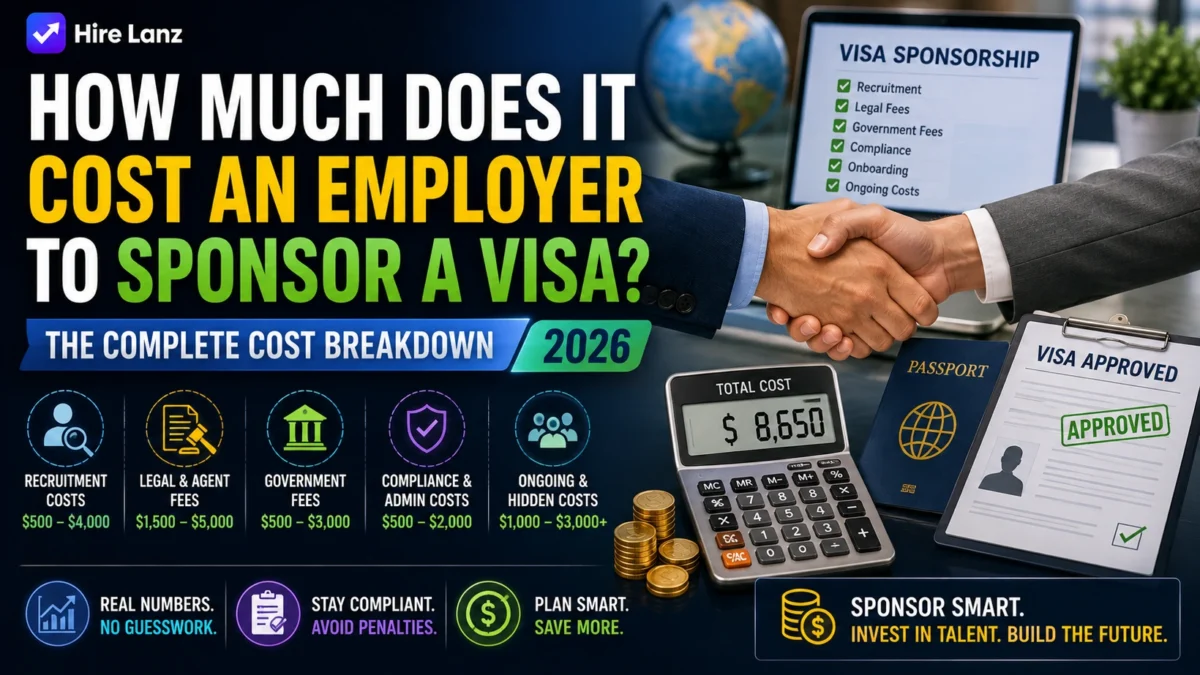
How much does it cost an employer to sponsor a visa in 2026? In the United States, a new H-1B petition costs roughly $2,200 to $3,600 in mandatory government fees, and $5,000 to $12,000 once attorney fees and optional premium processing are added. In the UK, a first Skilled Worker hire usually runs between £2,700 and £6,600 in employer-only charges. Your final number depends on three things: your headcount, the visa category, and how fast you need a decision.
What Visa Sponsorship Really Costs an Employer
Visa sponsorship cost is not one number. It is a stack of separate charges arriving at different stages, some paid to the government, some to a law firm, and some to vendors you have not thought about yet. A single H-1B filing involves five distinct government fees before an attorney sends an invoice.
Employer size drives most of the variation. US law splits companies at 25 full-time employees, and again at 50 for firms with a heavily visa-dependent workforce. Cross either line and your bill changes materially, even though the paperwork is identical.
Speed is the second lever. Standard processing is free but slow. Paying for a guaranteed 15-business-day decision adds nearly $3,000 per case, which is often the largest single line item on a small company’s invoice.
The third factor is whether you are sponsoring temporary work authorisation or permanent residence. A green card is a separate and more expensive project than the work visa that precedes it. Employers planning to keep a hire long term should budget for both from day one.
The 2026 Fee Breakdown, Line by Line
Here is what a new cap-subject H-1B petition costs in mandatory US government fees in 2026. Every figure below is the employer’s responsibility, and none of it is refundable if the petition is denied.
| Fee | Small Employer (1–25 FTE) |
Large Employer (26+ FTE) |
Qualified Nonprofit |
|---|---|---|---|
| Lottery Registration | $215 | $215 | $215 |
| Form I-129 Petition | $460 | $780 | $460 |
| ACWIA Training Fee | $750 | $1,500 | $0 |
| Fraud Prevention and Detection Fee | $500 | $500 | $500 |
| Asylum Program Fee | $300 | $600 | $0 |
| Mandatory Total | $2,225 | $3,595 | $1,175 |
Two conditional charges sit on top. Premium processing, filed on Form I-907, rose from $2,805 to $2,965 on 1 March 2026. And companies with more than 50 US employees where over half the workforce holds H-1B or L-1 status pay an extra $4,000 under Public Law 114-113.
Attorney fees are the piece most often left out of the model. A straightforward H-1B runs $2,000 to $5,000 in legal fees, rising past $8,000 for cases involving unusual job duties or a Request for Evidence. Add that to the table and the realistic all-in cost of one H-1B lands between $5,000 and $12,000.
Other categories follow different arithmetic. An L-1 transfer carries a higher base I-129 fee of $1,385 for large employers but skips the ACWIA fee entirely. An O-1 has neither the ACWIA nor the fraud fee, making it cheaper on paper, though the evidence package is heavier and legal fees reflect that.
A few points worth pinning to your budget sheet:
- The $215 lottery registration is spent whether or not your candidate is selected.
- Nonprofits, universities and affiliated research organisations are exempt from both the ACWIA fee and the Asylum Program Fee, cutting the mandatory bill by more than half.
- Filing with the wrong fee amount gets the whole package rejected, not corrected.
- An H-1B transfer still triggers most of these fees again, because the new employer files a fresh petition.
The $100,000 H-1B Fee: Where It Stands Today
In September 2025, a presidential proclamation added a $100,000 payment to certain new H-1B petitions, specifically those for beneficiaries approved through consular processing abroad. For affected employers it turned a $9,000 hire into a six-figure one overnight.
That fee is not currently enforceable. On 8 June 2026, a federal district court in Massachusetts vacated the policy in full, holding that a charge of that size functions as a tax the president cannot impose without Congress. The government appealed and asked for the ruling to be paused.
On 24 July 2026, the First Circuit refused that pause, finding the government unlikely to succeed on the merits. USCIS confirmed on its own fee schedule page that it will comply, while noting that DHS still intends to collect the payment if the order is ever lifted.
Two dates matter for planning. The appeal is unresolved, and courts in different circuits have reached opposite conclusions, so Supreme Court review is possible. Separately, the proclamation expires on 20 September 2026 unless extended. Confirm the position with counsel on the day you file, not from guidance written a month ago.
Costs Most Employers Forget to Budget For
The prevailing wage obligation is the largest financial commitment in sponsorship, and it never appears on a fee schedule. Filing a Labor Condition Application legally binds you to pay at least the Department of Labor’s prevailing wage for that role and location. If your candidate’s market rate sits below that number, sponsorship raises your salary cost permanently.
Compliance carries its own overhead. H-1B employers must keep a public access file, post LCA notices, and track worksite changes that can trigger an amended petition. Most companies absorb this in HR time rather than cash, until an audit turns it into a real expense.
Requests for Evidence are common and expensive. If USCIS asks for more documentation, your attorney bills for the response and your start date slips, sometimes by months. Sensible budgets carry a contingency of roughly 20 percent of the legal fee.
Then come the small items: credential evaluations for foreign degrees, certified translations, courier charges, and the cost of restarting a search if the lottery does not go your way. None is large alone. Together they routinely add $500 to $1,500 per case.
Costs that rarely survive the first budget draft:
- Prevailing wage uplift, which can exceed every filing fee combined
- RFE response work, typically $1,000 to $2,500 in extra legal fees
- Amended petitions when a worker changes worksite or role
- Extension filings every three years, repeating most original fees
Who Is Legally Allowed to Pay Each Fee
This is where employers create exposure without meaning to. Federal rules treat the H-1B petition as the employer’s filing, so its costs belong to the employer. Pushing them onto the worker can trigger back-wage actions and, in serious cases, debarment from the programme.
The mandatory H-1B fees are strictly employer-paid: the I-129 base fee, ACWIA training fee, fraud prevention fee, Asylum Program Fee, and the Public Law 114-113 surcharge where it applies. No written agreement from the employee makes recovery acceptable, because such an agreement conflicts with the required wage.
Premium processing is the one flexible item. An employee may pay it if the speed genuinely serves their own purposes rather than a business need, and only if the payment does not push their take-home pay below the required wage. Most employers simply pay it, since fast onboarding benefits the company.
On the permanent residence side, the split changes. All PERM costs, including recruitment advertising and the associated legal work, must be paid by the employer. From the I-140 onward the rules loosen, and many companies still cover those fees as a retention benefit rather than a legal duty.
Quick reference on payment responsibility:
- Employer must pay: I-129 fee, ACWIA, fraud fee, Asylum Program Fee, Public Law 114-113 fee, all PERM costs
- Employer usually pays: attorney fees, premium processing, I-140 filing
- Employee typically pays: consular visa application fee, dependant filings, adjustment of status
- Never negotiable: any arrangement reducing the worker’s pay below the prevailing wage
UK Sponsorship Costs and How to Cut Your Bill
UK employers face a different structure but a similar surprise. Before sponsoring anyone you need a sponsor licence, costing £611 for small or charitable organisations and £1,682 for medium and large ones. Since April 2024 the licence lasts ten years with no renewal fee, so it is a genuine one-off.
Per worker, you pay £525 for the Certificate of Sponsorship plus the Immigration Skills Charge, which rose 32 percent on 16 December 2025. Large sponsors now pay £1,320 for the first year and £660 for each additional six months. Small and charitable sponsors pay £480 and £240. The charge is due upfront when the certificate is assigned.
The arithmetic scales fast. A large sponsor issuing a five-year certificate owes £6,600 in skills charge alone, before the certificate fee, before legal advice, and before the worker applies for anything. Ten such hires means £66,000 in one budget year.
Crucially, the licence fee, certificate fee and Immigration Skills Charge cannot be recovered from the worker. Home Office guidance is explicit that recouping them will normally lead to licence revocation. The visa fee and the £1,035 annual health surcharge are legally the worker’s, though many employers cover them as part of the offer.
| UK Employer Cost | Small or Charitable Sponsor | Medium or Large Sponsor |
|---|---|---|
| Sponsor Licence (One-Off, 10 Years) | £611 | £1,682 |
| Certificate of Sponsorship (Per Worker) | £525 | £525 |
| Immigration Skills Charge (3 Years) | £1,440 | £3,960 |
| Optional Priority Licence Service | £750 | £750 |
Practical ways to reduce the cost of sponsoring an employee:
- Check exemption status first. US nonprofits and universities avoid two fees entirely; UK sponsors are exempt from the skills charge for PhD-level roles and for workers switching from a UK student visa.
- Match the certificate length to the real role, since the UK skills charge is paid per year upfront.
- Skip premium processing where the start date allows, saving nearly $3,000 per US case.
- Check whether the candidate qualifies for a route that avoids PERM, such as EB-1C, removing $5,000 to $10,000 of legal work.
- File in-house where volume justifies it, using counsel for review rather than full preparation.
Summary
The cost to sponsor a work visa splits into three layers. Government fees are fixed and predictable: $2,225 for a small US employer filing a new H-1B, $3,595 for a large one, or £1,965 to £4,485 for a UK Skilled Worker over three years. Legal fees add $2,000 to $5,000 per US case. The third layer, made up of prevailing wage obligations, compliance time, RFEs and extensions, decides whether your budget holds.
Frequently Asked Questions
How much does it cost an employer to sponsor a visa in the United States?
Budget $2,225 to $3,595 in mandatory USCIS fees for a new H-1B, depending on whether you have fewer than 26 full-time employees. Attorney fees and premium processing bring the realistic total to between $5,000 and $12,000 per petition. Green card sponsorship is a separate project costing $6,000 to $15,000 more.
Can an employer make the employee pay the sponsorship fees?
Not for the core H-1B fees. The I-129 filing fee, ACWIA training fee, fraud prevention fee and Asylum Program Fee are legally the employer’s, and recovering them from the worker can trigger Department of Labor penalties. Premium processing is the narrow exception when the employee requests it for their own benefit.
Is the $100,000 H-1B fee still being charged?
No. A federal court vacated the policy on 8 June 2026, and the First Circuit declined to reinstate it on 24 July 2026, so USCIS is not currently collecting it. The appeal remains live and the underlying proclamation expires on 20 September 2026, so confirm the position before filing.
Do small businesses pay less to sponsor a visa?
Yes. Employers with 25 or fewer full-time employees pay $460 rather than $780 for Form I-129, $750 rather than $1,500 in ACWIA fees, and $300 rather than $600 for the Asylum Program Fee. That saves roughly $1,370 per petition. UK small sponsors also pay a lower licence fee and skills charge.
How much does UK visa sponsorship cost per worker?
Expect £525 for the Certificate of Sponsorship plus the Immigration Skills Charge, which is £480 per year for small sponsors and £1,320 per year for medium and large ones. A three-year hire therefore costs £1,965 for a small sponsor and £4,485 for a large one, before legal fees.
Is sponsoring a green card more expensive than a work visa?
Generally yes, because PERM labor certification requires real recruitment advertising and substantial legal work. Employers typically spend $6,000 to $15,000 across the PERM and I-140 stages. The employer must cover all PERM costs by law, though later adjustment of status fees can fall to the employee.
Conclusion
How much does it cost an employer to sponsor a visa comes down to a question most companies answer too late: what are you actually buying? Not a form, but several years of legal obligation, wage commitment and compliance work attached to one hire. The filing fee is only the entry ticket. Before you commit, do three things. Confirm your employer size category, because it changes almost every figure on the page. Get a written legal quote specifying whether RFE responses and amendments are included.
Related Articles:
Highest-Paying Jobs That Help People: 2026 Salary Truth
How Many Days Can I Work Abroad Without Paying Tax? The Complete 2026 Guide




Leave a comment